

When I went to see Melania this week, it was my first visit to a movie theater in more than a year. And my trip in 2024 was to write up Megalopolis for this blog, so outside of hilariously awful movies viewed for content-generation purposes, I haven’t been to a movie theater in about three years.
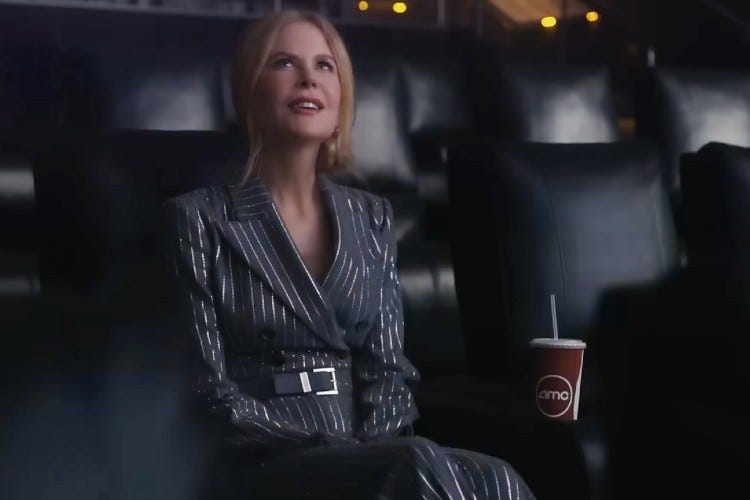
I wouldn’t share that fact with my friends in entertainment. That movie theaters are struggling is widely known in entertainment and, well, everywhere — I’m fairly sure that uncontacted tribes in the Amazon have at least an inkling of that reality. As a result, it’s now uncool in LA to admit that you streamed a movie from home — you’re supposed to go see it in the theater. And actually: You’re supposed to see it in the theater and then bray like a jackass about how magical and immersive the experience was. There’s a sense in entertainment that moviegoing can be saved if we just pull up our socks and rally around plucky underdog gigantic theater conglomerates like Regal and AMC. This ethic has been championed in print by Christopher Nolan and Steven Spielberg, and by Nicole Kidman in this famous commercial:
I honestly find that ad somewhat persuasive. Going to the movies can be fun! And I’m old enough to be nostalgic about movie theaters. But the strongest counterpoint to this argument is the experience of actually going to a theater.
I paid $15 to see Melania at 1:30PM on a Monday. I had to drive to the theater, and I had to wear adult human clothes, because I’m three-to-five years from the age where I’ll say “fuck you, society” and hit the town in sweatpants and slippers. There were no toddlers or rowdy teens in my theater, but that was mostly because those groups aren’t exactly the target audience for Melania. Concessions were sold at Weimar Republic prices, so I skipped them altogether. And the movie was preceded by a full 30 minutes of “coming attractions”, some of which were just ads, including the Nicole Kidman ad, which I thought I’d be spared because I was already in the fucking theater.
Compare that to the experience of streaming a movie at home. I’m in my own house, so I can wear whatever, and I am at an age where “pants required” is something very close to a dealbreaker. The movie starts when I want it to. I’m free to make hilarious comments, and when my wife says “Haha so funny but you talked over the dialogue,” we can rewind. We can pause and pick it up tomorrow if we get tired. I’ve got soda in my fridge and would have to chug six liters before I’d approach the price of a “small” soda at the movies. The only toddler who can ruin the movie is my toddler. The only annoying jackass who will talk over the movie is me. This all costs about $6, $6.80 if you include enough soda and popcorn to put my entire family in a coma. Meanwhile, the “equivalent” (actually inferior) experience at a movie theater would run $70-$80.
And I haven’t even addressed the fact that in my humble opinion, 98.3% of all movies these days are unwatchable trash that I wouldn’t inflict on a convicted terrorist.
Has trying to bully people into buying an inferior product ever worked? Did the push to support brick and mortar retail slow Amazon’s rise even a little? Did the campaign in the ‘70s and ‘80s to get people to buy American cars keep Toyotas and Nissans off of American streets? Maybe these efforts had some impact — Toyota does advertise that they have plants in the US. But it seems like in the end, whichever product is the best value for money will always win out. Case in point: My grandpa drove a Toyota even though he spent three years of his life being shot at by Japanese people. But he wasn’t going to let a little thing like a world war stand between him and the affordable dependability of the Toyota Corolla.
It’s hard to watch a thing you love disappear. For me, the slow, sad death of late night comedy has been excruciating. But streaming, podcasts, and — let’s not leave this part out — hackery have basically killed the genre. People would watch late night TV if they wanted to watch late night TV, and there’s probably no ad I could film about the magic of sneaking into the living room at 12:30AM, making a Totino’s party pizza, and watching Conan that would change people’s minds.
In the end, these campaigns strike me as the real-life version of the old SNL ad for carbon paper:
Comedy writers in 1989 knew: Carbon paper was a dead technology walking. I wonder, though: If this ad had been real, and if it had been put into heavy rotation by the Carbon Paper Manufacturers of America, would it have made any difference? Perhaps — maybe if that had happened, people today would use carbon paper and loudly tout how much they prefer the earthy and tactile experience of carbon paper. But far more likely: People would have used whichever product best served their needs like they have since the beginning of time.
Six Theories About Why Comedy Movies Died

Variety recently published their list of the “Best 100 Comedies of All Time” (the full article is here, and just the list is here). I’m not here to debate the list; I know that these things are highly subjective and just for fun. That being said: Making a list of the 100 best comedies that doesn’t include

Apparently Substack does not yet support including images in Comments (and I'm sure there are good reasons for that), but in the vein of your story about your grandpa, Jeff, I have a pic of a "Pearl Harbor Survivor #205" license plate on a Honda Civic.
Who’s bullying, though? All the cited instances look more like (attempted) persuasion to me. That’s what ads and op-eds do. You may disagree with their conclusions or with the strength of their arguments (I do—I haven’t been to a theater in close to a decade, for exactly the reasons outlined here), but they’re just trying to persuade you to go to the theaters, not bully you into it.