

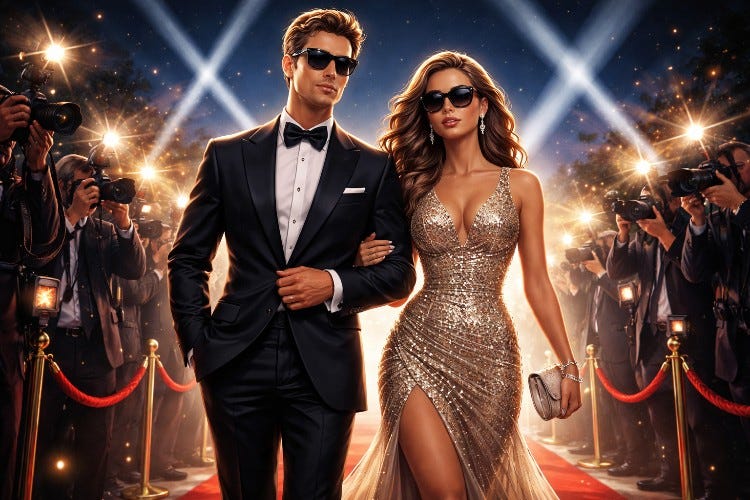
Recently, fellow Substacker Cartoons Hate Her wrote a very good article about how regular-looking (or at least more-regular looking) actors are underused in TV and movies. Her argument is basically that normal-looking actors help ground a show, and when you have, say, a bus driver played by Brad Pitt, it’s weird any time a character gets on the bus and doesn’t say “Holy shit dude — you look like Brad Pitt.”
I think she’s got an excellent point. Some of my favorite shows and movies like Fargo, Peep Show, and the British Office — the latter two of which are discussed in CHH’s article — rely on actors who lack fashion-model looks. I think that using actors closer to the global attractiveness mean helps a movie or show feel more real. It also makes casting easier, because it’s hard enough to find an actor who A) Can capture what you need, B) Fits in your budget, and C) Is a tolerable level of insane. If you add: D) Must be in the 99.8th percentile of human attractiveness, casting gets harder, plus your odds of meeting condition C go way down.
So: Good article, great points, and also…not gonna happen. Not in a jillion years, not in this universe or any parallel universes that might exist. My time in TV helped me understand the value of eye candy, and while CHH makes good points about how believable-looking people help create believable worlds, there are good reasons why acting will always be dominated by folks who are pleasing-to-hot.
Consider the American Office and the British Office, which is a comparison CHH makes in her article. It’s natural to assume that the differences between the shows are due to differences in audience sensibilities — we might assume that Brits prefer humor that’s more witty and subdued (a theory that holds up until you recall the tit-and-saxophone-based comedy of Benny Hill). But I would argue that the differences mostly stem from a non-cultural factor: A standard TV season in America is 20-something episodes, while the Glorious People’s Broadcasting System of Britain will let you get away with six. There were ultimately 201 American episodes of The Office and only 14 British ones, and I think that disparity drove most of the differences.
The British Office was relentlessly bleak — that’s why it was a singular piece of comedy — and you wanted to fucking murder David Brent at the end of those 14 episodes. People will sit through 14 episodes of bleakness, but 200 episodes requires a different vibe. American Office showrunner Greg Daniels has talked about changes to the American version that made it less bleak, most notably making Michael Scott more of a “frustrating uncle” than a guy you wanted to see beaten to death with a pipe. Other changes included the outer-orbit Dunder Mifflin employees getting fleshed out, the full realization of the Jim and Pam romance, and the addition of several other romances. In the end, Dunder Mifflin (American version) seemed like a much happier place to work than Wernham Hogg (British).
The glow-up from Tim & Dawn to Jim & Pam was one thing that made the tableau brighter. It’s important to note that Martin Freeman and Lucy Davis (Tim & Dawn) don’t exactly have “UNFUCKABLE” tattoo’d on their foreheads — far from it. But it’s also true that NBC’s wardrobe department really had to up its wrinkled-shirt-and-dowdy-sweater game to make John Krasinski and Jenna Fischer (Jim & Pam) pass for regular people. Those actors are both extremely easy on the eye, and that fact contributed to people coming back 200+ times to see them. It’s also worth noting that the British Office was not initially a hit: It was a critical and comedy nerd darling that got retconned into a massive global hit after the Jim & Pam-themed version took off.
I once had a producer very politely key me in to the public appetite for seeing hot people hook up. I was writing for American Auto — a show that happened to have several Office veterans — and a pitch session at the beginning of season two involved what to do with the intra-office romance that had budded in season one. I wanted to ditch it — I thought there was a better pairing between two characters who had a platonic “work husband/work wife” relationship that I thought could be the emotional center of the show. When we broke for lunch, this producer opened his laptop and showed me the online chatter surrounding season one: It was overwhelmingly about how people wanted to see the two very hot people on our show bang often and well. I had my artsy ideas about innovative character pairings, but this producer gently informed me that there probably was no replacing the public appetite for seeing two smokeshows hook up. And I think he was right.
Did Game of Thrones’ ratings suffer when the writing went from “historically good” to “so bad the FBI probably should have opened an investigation”? No, because people wanted to see Kit Harington and Emilia Clarke knock boots. Was Friends perhaps helped by the fact that the attractiveness of the titular friends made the median Leonardo DiCaprio girlfriend look like a trash can full of pus? Yes, obviously. Hot people are neither a necessary or sufficient condition for a hit, but they definitely help. After several thousand years of entertainment, no one knows the algorithm that makes something popular, but all would agree that “people who are nice to look at” is an important variable.
And there’s one more thing: When we watch TV and movies, we’re projecting ourselves into the characters. That’s why we care what happens — we’re imagining ourselves as those people. And since your characters are stand-ins for the audience, you want those characters to reflect how people think of themselves, not how they actually are. Therefore, an “everyman” character (or an everywoman) is really every man plus about three-to-four points on the 1-10 scale. You want the audience to look at the character and think “that’s me”, and people won’t do that if the character looks like shit.
Ultimately, it comes down to the age-old question: Is entertainment art or commerce? The correct answer is “commerce” — sorry folks, art is dead, or more accurately: It never existed. Of course, just because something is commerce doesn’t mean it can’t be good — it you do it right, people will find intense enjoyment or deep meaning in the commerce. But every TV show or movie is ultimately someone’s investment, a producer spent money to make the thing with the intention of getting the money back (and then some). So, the creative people need to pull out all the stops to help the thing succeed, and populating a visual medium with nice-to-look-at people is a no-brainer. Most people don’t want intense realism — they get enough of that in reality. So, while I agree that shows with regular-looking people can be more engrossing than shows where every Denny’s waitress and homeless guy look like runway models, they’re surely less lucrative on the balance, so they’ll probably remain rare.
Down With Art, Up With Craft

When people ask me whether comedy is art, I always say “no”. That’s because I think what’s really being asked is: “Do you want to make yourself sound important? Do you fancy yourself to be some avant garde truth teller bestowing wisdom on the ignorant masses? Are you going to start wearing berets and Johnny Depp scarves, and to sip tiny Italian coffee w…


I have this theory that the key distinction between UK and US comedy comes down to the class and social systems each is made within. Thanks to the American Dream, the Americans believe in social mobility, and thus US comedy is more aspirational. In the UK, however, the British know full well that if they're on the lower levels, no matter how hard they work they ain't never getting up to the higher decks, because you need to have an ancestor who invaded with William the Conqueror to get that high. So UK comedy is more resigned in a kind of Albert Camus "Sisyphus getting so resigned to pushing the rock up the hill that he starts to see the bright side of it" way. You Yanks have the inspiring "we're gonna make our dreams come true!" mindset, while we Brits have more of a "yeah, it's probably not gonna happen, but fuck it, gotta laugh, haven't you?" thing going on. (Even Benny Hill is not an exception to this: yeah, sure, hot babes, but who's the guy in the middle we're focussing on? A squat fugly troll chasing them around who usually ends up falling into a puddle or something, his dreams of groping blonde bimbos thwarted by his own ineptitude.)
In it's way, this discussion re: UK vs US Office kinda exemplifies this well; UK Office puts the schlubs up front and centre, because pretty much everyone watching BBC Two on Thursday night or whenever it was on knows full well they ain't winning any beauty pageants and doesn't need to be deluded into thinking the person representing them on the show could. US Office, however, needs to cater to the stereotypical viewer's aforementioned belief that they're a Jim / Pam capable of landing a Vice / Versa, so it hottifies the main cast up a few layers and puts the schlubs firmly at the margins so that everyone watching can pretend they're not actually the Kevin or the Meredith.
(This also explains why Americans who watch it are intractably convinced that the UK Office is unremittingly bleak and dark, whereas the British generally look at it and go "Eh, I've had worse.")
There's clearly a spectrum here, with Spanish-language weather broadcasts on one end and British comedy shows on the other. The fact that we find the hotness of telenovela actresses jarring enough to be the subject of running jokes on Arrested Development seems to indicate that there is some limit to our dumb preference for hot people. Maybe we'll never make it all the way to Jeremy Clarkson territory, but maybe someday there will be at least more room for normal-ish looking people in American TV.