


It’s time for the columnist equivalent of crowd work: a mailbag column. Why should I dominate the conversation — let’s talk about what you want to talk about! And by “you”, I mean “readers who wrote in with questions about things that I want to talk about.”
For future reference: Questions go to questions@imightbewrong.org. Paid subscribers are far more likely to have their questions answered, and that’s not only because 80 percent of my unpaid subscribers are illiterate. Let’s dive in!
From Max: If you could design a university course on the history of 20th and 21st century comedy, what would be on the syllabus?
I’m going to make two assumptions: 1) This is a 15-hour semester course, and 2) I can’t be fired or dragged into Whiny Student Hell for assigning material that some would consider offensive. And that’s important, because I can hardly cover over a century of comedy if I’m only allowed to assign JibJab videos and reruns of Alf. So, here’s a hypothetical class that would never exist in the real world due to assumption #2.
Class 1: Vaudeville: what is a joke? (alternate title: Which ethnic stereotypes are the funniest?)
Assigned material: Who’s on First?, Henny Youngman
Class 2: Silent film: the importance of visuals. (alternate title: Why is it funny to watch someone almost die?)
Assigned material: Charlie Chaplin’s Modern Times, Buster Keaton’s The General
Class 3: Satire — mocking the recognizable. (alternate title: How to flatter people’s egos by sharing their opinions)
Assigned material: The Marx Brothers’ Duck Soup
Class 4: Three-camera sitcoms — your life, but better. (alternate title: What if some fuckup schlub husband could still have a hot wife?)
Assigned material: The Dick Van Dyke Show, The Jeffersons
Class 5: Subversive comedy — freaking out the squares. (alternate title: Butchering sacred cows all the way to the bank)
Assigned material: Monty Python’s The Life of Brian
Class 6: Absurdism — nothing makes sense, nothing matters. (alternate title: What’s the exact right amount of drugs to do while writing comedy?)
Assigned material: Airplane!, Conan’s “Satellite TV” bit
Class 7: Political comedy — the challenge of being more interesting than the PBS Newshour. (alternate title: Voltaire, but retarded)
Assigned material: Mort Sahl, SNL’s Bush/Gore debate sketch, Key & Peele “anger translator” sketch, The Daily Show on the night of the Dick Cheney hunting accident
Class 8: Standup comedy — laughing at someone laughing at themselves. (alternate title: A socially acceptable forum in which to say “fingerblast”)
Assigned material: Louie CK’s Chewed Up, Eddie Izzard’s Dress to Kill
Class 9: Sketch comedy — a crazy person walks into a bar. (alternate title: Yelling catchphrases while wearing wigs)
Assigned material: Chappelle’s Show “Clayton Bigsby” sketch, SNL “Motivational speaker” sketch, The Kids in the Hall “Eradicator” sketch, Mr. Show’s “Pre-taped call-in sketch”
Class 10: Improv comedy — people love a high-wire act. (alternate title: Your friend’s troupe is not the apotheosis of the form)
Assigned material: TJ & Dave
Class 11: Low-budget comedy movies — taking many low-stakes swings for the fences (alternate title: Throwing $2 million at some young punk and seeing if he strikes gold)
Assigned material: The Jerk, Superbad
Class 12: Late night shows — sublime filler (alternate title: One good joke a night, five nights a week)
Assigned material: Johnny Carson’s monologue, Rodney Dangerfield on Carson, Letterman’s “Stupid Pet Tricks”, Will Ferrell as Robert Goulet on Conan
Class 13: Single-camera sitcoms — the joke bucket becomes optimized (alternate title: Quantity traded for quality, and then cancelled)
Assigned material: Arrested Development, 30 Rock, The Simpsons
Class 14: Musical comedy — the hard-to-access cheat code (alternate title: Great — now I’m lacking talent in two genres)
Assigned material: Weird Al “Eat It”, Tenacious D “Tribute”, Lonely Island “Lazy Sunday”, Flight of the Conchords “Business Time”
Class 15: Independent creators — total freedom, utter irrelevance (alternate title: The gatekeepers are gone and we miss them)
Assigned material: Bo Burnham “Welcome to the Internet”, Zach Galifianakis “Between Two Ferns”, Kyle Gordon “Mr. Jambo”, Nicole Daniels “Nonprofit boss”
From Steve: [Steve references a recent Pod Save America episode in which the DSA was lauded for their ability to "energize young people", which is something they feel the Democratic Party fails to do right now. And Steve asks…] If you were part of the Democratic Party leadership, what would your advice be to capture the DSA energy without capitulating to the DSA?
Oh Lord…I’m part of Democratic Party leadership in this scenario? What Greek God did I fuck over to bring this living hell into existence? Regardless, I’ll try to see if I can find something to say other than “This is your mess and I resign.”
My first advice would be to not worry too much about failing to match the energy of DSA zealots — zealots are definitionally energetic and motivated. Consider the number of people wearing masks at this recent DSA meeting:
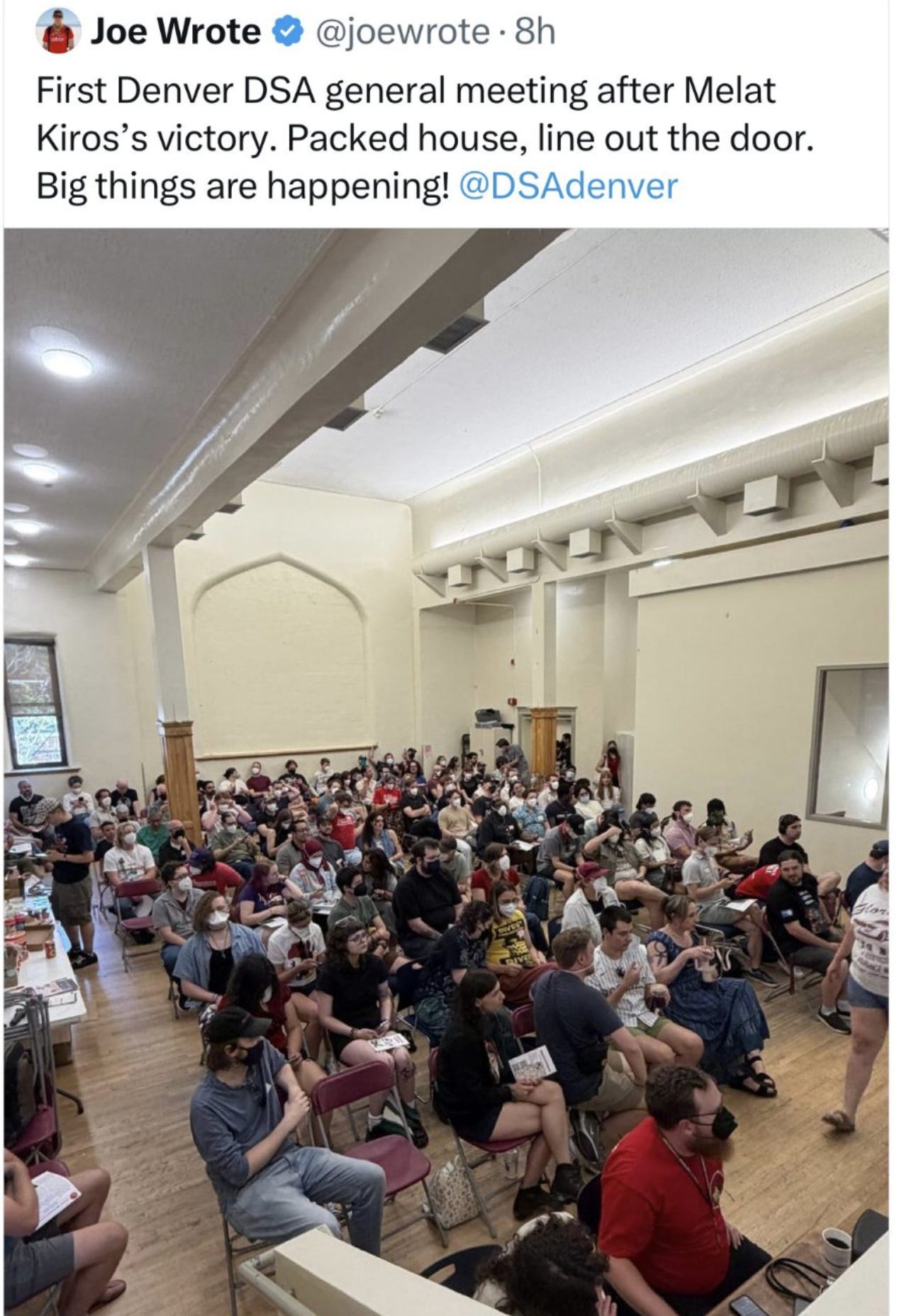
Does it take commitment to still wear a Covid mask four years after most of us gleefully set our mask ablaze and peed on the ashes? Yes! But that doesn’t make it a sensible thing to do.
My other advice would be to not try to split the baby with the DSA. Many leftists’ identity is based on placing themselves in opposition to the mainstream, which means that when you move left, they move left in order to remain edgy. Recent attempts at appeasement have not gone well: Elizabeth Warren flopped in 2020 running as Bernie Lite, Biden’s slew of concessions to the progressive wing didn’t prevent a leftist revolt, and the recent DSA primary victories have exclusively come against highly progressive Democrats (several were co-sponsors of Bernie’s Medicare for All bill!). The DSA wants you all-in, and going part-of-the-way-in will probably cost you moderate votes but not prevent you from being called a handmaiden of the Epstein class.
I would also point out that trying to craft a perfectly inoffensive-to-all-parties persona is antithetical to inspiring enthusiasm. People want to follow leaders — they’re turned off by politicians who come across as inauthentic and calculating. As it happens, the DSA is adamant on this point — that’s why they developed instant puppy love for Graham Platner’s seafood-scented machismo and decry “smoothgroin” politics and “Tracy Flick types”. There’s an undercurrent of masculine energy in DSA politics; it contrasts with the often-feminine energy of the mainstream Democratic Party. So, counterintuitively, a politician could possibly siphon some of the DSA’s mojo by clearly and forcefully telling them to jump up their own asses.
I’ll cite what I’ve previously said about Israel-Palestine as an example: In a presidential primary, it’s not going to be possible to fudge that issue. My advice is to loudly embrace the complexity: Affirm your desire for a two-state solution, resist all efforts oversimplify the conflict, and inform everyone who’s annoyed by that that they are free to lick your balls. And perhaps the “lick my balls” part is optional, but I think it should at least be implied.
From Jacob: What is your opinion of conservative readers who read and appreciate your work?
20 years ago, I would have thought it was odd; now, I get it. And that’s because the fringes of American politics have grown, which has shrunk the perceived differences between conservatives and liberals.
Of the many explanations for the changes in our politics over the last 20-ish years, I think an underappreciated one is that the World War II generation died out. That generation witnessed real communism and real fascism and did not think that either was cool; the edgelord takes about Hitler and Mao that exist these days are possible largely because young people usually don’t have a firm grasp on what those guys did. But for about 50 years — basically the adult lifespan of the Silent Generation — fringe politics were fringe and both parties were mostly what you’d call “classically liberal”. There would be heated debates about things like gay rights and the top marginal tax rate, but not things like whether the last election was secretly rigged or whether the streets should run red with the blood of bankers and landlords.
Today, one party is dominated by a right-populist know-nothing, and extremists on the other side are trying to exert control. In that context, the distance between old-school liberals and conservatives seems small. I probably disagree with the typical Wall Street Journal reader on Obamacare and climate change, but we probably agree that Joe Biden won the 2020 election and we should not model our economy on The Great Leap Forward. I think a lot of people are sensing that compression, so when a small-c conservative encounters me — a political comic full of hot takes like “Hamas is bad” and “supply and demand exist” — I seem a lot more tolerable than I might have seemed back when we were debating Don’t Ask Don’t Tell and the Bush tax cut.
From Greg: [Greg notes that I’ve become an accidental aficionado of 1920s jazz due to the copyright-expired music I use on my podcast, and observes that songs of that era often have themes that — to put it delicately — are very outdated. And to put it not delicately: They’re so fucking racist they could stop time. And then he asks…] What is the moral calculus of playing songs, sometimes songs that we do not even sing the words to, that contain some cringeworthy allusions or phraseology of an earlier time?
I think the best approach to that stuff is a straightforward approach: Acknowledge that old art often contains things that were considered okay a long time ago but are not considered okay now. And if you’re with a child, who needs guidance from adults about what’s acceptable and what’s not, it probably makes sense to make it clear that the old ideas are bad.
I feel like the alternative — hiding things, censoring things — gives those the allure of forbidden fruit; I’m reminded of The Simpsons’ “What is your fascination with my forbidden closet of mystery?” joke. It also treats people like children; I think grown-ups are capable of encountering these things and understanding what they are. To wit: My wife and I recently watched Gone with the Wind (she had never seen it), which — as you may have heard — is a very racist movie. Ugly stereotypes abound, and the South is treated as the unambiguous good guys. But the movie remains a cultural artifact — still the highest-grossing movie of all time adjusted for inflation — and both of us heroically managed to make it through the 962-minute runtime without being brainwashed into thinking that the antebellum South was good. And the disclaimer that HBO put at the beginning saying “Warning: Ahead thar be racism” put the movie in context for anyone who didn’t know what they were getting into.
I think that the matter-of-fact approach marginalizes the bad elements of old content and avoids treating it like powerful magic. It also solves the throw-the-baby-out-with-the-bathwater problem, because, sure, the “call me Loretta” joke in The Life of Brian doesn’t play well these days, but if I disown everything that contains anything problematic, I’ll only be able to watch a few Bluey episodes and Mr. Magorium's Wonder Emporium. A more dignified approach is to acknowledge that old stuff frequently contains outdated views, and those views are, indeed, outdated because societies evolve.
That’s all for today! Thanks very much to everyone who wrote in!
The Great Dumbening

Recently, Elon Musk — a man I simply can’t get myself to care about — tweeted the cartoon shown above. It got a lot of attention, and I understand why; it’s hard to deny that something is happening on the left. I thought about the stick figures for frankly way too long. It was hours — I eventually started to feel like I was pondering the allegorical sub…
Voters Think Democrats Are Racist

A recent finding by political scientists at UC Berkeley and Yale has been getting a lot of attention. The researchers studied which opinions by hypothetical political candidates changed voters’ opinions the most, and the part that I highlighted below — the bit that academics are too prudish to call “the money shot” — is what I want to talk about.
Counterpoint: the “I want to be called Loretta” exchange in "Life of Brian" is one of the most relevant, and prescient, bits in the entire movie.
Wait, you're NOT a conservative? Then to hell with this. :)
Yes, as that WSJ reading, Trump disliking conservative you're describing, we probably have a lot more in common than we do with large parts of either party at the moment. It's easy to get wrapped up in labels, so I'm going to do precisely that. I suspect you and most of the people reading this are liberals - some who are left-liberals and others right-liberals (aka the Artist Formerly Known as Conservative). We may disagree about specific policy, but philosophically we have more in common with each other than either the post-liberal right or the DSA-addled left.