

I’ve been watching clips of Dolly Parton and asking myself: Why do I like this? Because I don’t like country music…contemporary country music, anyway. It hits my ear like bad ‘90s rock — most of it sounds like a Matchbox 20/Third Eye Blind supergroup fronted by Larry the Cable Guy. It also turns the pandering up to infinity: Every song is about beer, trucks, whiskey, jeans, and other things on the Taboo card for “southern stuff”. I makes me picture cigar-chomping music execs in Hollywood typing “What stuff do the shit-kicking bumpkins who buy our records like?” into a Professor Frink-style supercomputer.
But I like old country music. Johnny Cash, Hank Williams, Waylon Jennings — I’m a sucker for anything that’s just a guy, a guitar, and substance abuse problem. I’m also just old enough and just southern enough1 to remember the culture that produced Dolly Parton; I think one reason people loved Dolly so much is that she was an ambassador from a different time and place. I don’t know how to measure the cultural distance between where Dolly ended life and where she began — which was basically the cabin from The Jerk — but it seems like a good place to start might be the show Hee Haw.
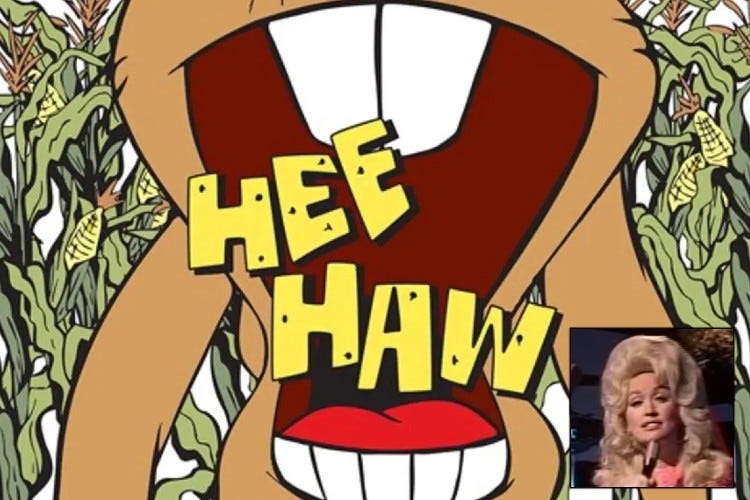
Hee Haw was Laugh-In for rednecks — that’s how it was conceived by the Jewish, New York-born, NYU-educated TV executive who created the show. My dad watched Hee Haw, and since we only had one TV — top that hardship story, Dolly! — I watched it, too. The show was corny as hell, literally: The show was set in “Kornfield Kounty”, and in fact, “Gee Maw, this show sure is CORNY” (gestures to cornfield) is exactly the type of humor the show featured. They also had musical acts — always country — and that’s where we get the clip of Dolly singing “I Will Always Love You” that’s being shared right now. I was able to find that whole episode on YouTube, and I feel like the lead-in to Dolly’s set perfectly captures Hee Haw’s bizarre, Catskills-meets-Appalachians vibe.
Maybe I’m projecting, but I detect just the slightest amount of “What the fuck was that?” on Dolly’s face.
I’m not here to gaslight you into thinking that Hee Haw was a good show. I try to appreciate old things — I like to understand where they fit in the culture and how they influenced what came later — but that doesn’t lead to takes like “Hawaii Five-O was tropical Shakespeare”. But watching these clips did remind me of something that I think Hee Haw legitimately did well.
The show was unpretentious. They acknowledged that the jokes were bad — gags often ended with the joke-teller being dunked in water, whacked over the head with a purse, or smacked by a fence (pictured). You can accuse Hee Haw of a lot of things, but you can’t accuse it of taking itself too seriously. When we think of positive traits, we usually think of superlatives — things like exceptional bravery, intelligence, or skill. But one highly positive trait is simply not trying to place yourself above other people. And Hee Haw was never too cool for school.
Dolly Parton was unpretentious. That remained true even as she ascended from backwoods nobody to country star to national treasure. She often told self-deprecating stories — when listing Dolly’s influences, one should not overlook Joan Rivers. In an industry in which egos often collapse under their own weight like a dying star, Dolly stayed humble.
I find a lot of classic country music to be unpretentious. The song was often just a singer and a guitar, decidedly in the folk/blues genre. But I feel like modern country gets far more of its DNA from pop than from folk/blues. The hillbilly schtick also usually seems put-on, whereas the country stars of yesteryear really were redneck nobodies and they really did have substance abuse problems — I’ll believe all these songs about whiskey when somebody gets drunk and burns down a forest like Johnny Cash did. I’m sure there are country stars who don’t deserve my shade; I don’t know the genre well enough to know the exceptions. But so much of what I see seems forced, overproduced, and anything but simple.
I don’t know what caused this change; I’m too busy trying to trace how technological changes altered political currents to know why modern music is how it is. And maybe I’m experiencing negative recency bias — maybe Lainey Wilson would seem authentic to me if I discovered her in the year 2100. But it does seem like pop has swallowed another genre — all music appears to be converging towards one over-produced, mid-tempo singularity. Which does have the effect of making the good-but-simple stuff stand out, which will probably help Dolly’s songs live on even now that she’s gone.
Why the Drunken, Brawling Irish Got Me Thinking About Hannah Gadsby

For whatever reason, this year I really noticed the flamboyantly non-PC nature of St. Patrick’s Day. Drinking is the cornerstone of the whole thing, so much so that even hipster cocktail bars will slap a paper leprechaun on the wall and dye their twee bottles of liqueur made from daffodils bright green. The obviously-not-Irish are encouraged to participate, and fake accents abound. My son’s preschool class covered green paper plates with stickers of shamrocks, rainbows, and buckle-clad green stovepipe hats, and I wondered what the equivalent project would look like for, say, Chinese New Year or Cinco de Mayo.
Remembering the New Year's Eve That I Got Big-Timed By Third Eye Blind

This story involves the radio, so to some readers, this will be like a story about steam-powered streetcars.
I grew up in Kentucky in the ‘80s.
My paternal grandparents were both from Eastern European immigrant families (Ukranian and Czech, respectively), lived their whole lives in Pittsburgh, likely never went anywhere further south than West Virginia, and they loved Hee Haw. It was a vibe, for sure.
Oh, those old country stars were real as hell. Merle Haggard was in and out of prison, for real crimes, and decided to launch a serious songwriting career after seeing Cash perform at Folsom (where Merle was a prisoner, not some "honored guest").
You feel the authenticity. Now you just feel the industry and America's Got Talent pushing these folks along.