

I’m glad that some folks have decided to debate whether Project Hail Mary was too long instead of talking about the Iran War. I want in on that — I don’t know what else to say about the Iran War. I wish we didn’t have The Dumbest and Drunkest in charge. Let’s hope it ends soon so that the mullahs can get back to shouldering the blame for ruining their country and Trump can get back to his real passion: interior decorating.
Matt Yglesias recently gave his thoughts about why movies are getting longer, and Frank Bruni weighed in yesterday. I think that Matt and Frank nailed the main two causes of this objectively-true phenomenon:
Movies had to be short when theater screen time was precious, but now that owning a movie theater is a like owning Party City in Eastern Ukraine, theaters are more amenable to movies with long run times.
Because basically everyone would rather watch a movie at home, pantsless, and farting with brio while suffering no social repercussions, studios are trying to coax people back to theaters with “event” movies.
Notice that both of these reasons relate to the trend of studios relying on a small number of big-budget movies. Low-to-middle budget movies in which a chimp attends college or 50-somethings in Martha’s Vineyard grapple with divorce are extinct. Basically everyone agrees on the dynamic: The movie industry has changed, blockbusters are make-or-break events for studios, and changes in the business have driven changes in substance. But why is length the result? I think there are a few factors beyond the ones that Matt and Frank identified.
One thing that seems trues is that CGI-heavy action sequences are basically un-cuttable. Movie scripts often change a ton — your gritty drama about a heroin-addicted poet will turn into an animated romp starring a rapping beaver. As the story changes, scenes that once seemed essential become extraneous, and stuff that isn’t working gets cut. The expression “Kill your darlings” exists because writers think that all of our ideas are flawless, brilliant gems, so we need a tough-but-fair person somewhere in the process to say “that sucks and it’s cut”.
But if a metric fuckton of money and God-knows-how-much production time have been spent on a huge sequence, there’s no way in hell that’s getting cut. This isn’t just sunk cost fallacy — this is sunk cost fallacy plus the knowledge that if you go to your boss and say “We wasted $10 million of your money,” your boss will say “I understand, I respect your honesty, now step into this rocket: I’m going to fill it with scorpions and fire it into a volcano.” Most projects start bloated and get edited down, but if you hired half of Taiwan to spend a year animating a scene that also required shutting down Italy for a week and building a full-scale replica of the moon, you can’t say “Ehh…it feels redundant. Cut it.”
Blockbusters are also written differently than other movies. Summer tentpole scripts tend to get passed around like liquor at a 9AM meeting at the FBI; it’s common to have several writers take a pass at a script, with the number going up every time an executive thinks “fucking fuckballs we’re fucking fucked”. Film industry blogger Stephen Follows tracked the average number of writers on feature films, and sure enough: The number has gone up over time:
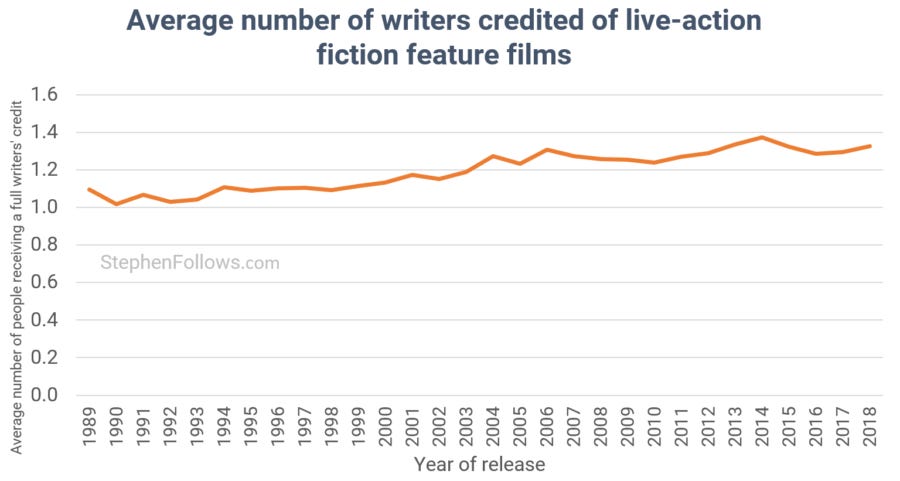
And the genre with by far the most multiple writers is “adventure”, i.e. “summer popcorn fare in which a robot fights an elf or whatever”.

When different writers with different visions take passes at a script, you often end up with ten pounds of story in a five pound bag. You might struggle to cut things, and you might not be able to cut things if some scenes have to stay just for later scenes to make sense. The expression “a camel is a horse designed by committee” very much applies to screenwriting: A camel is a horse with extra parts, some of the parts are fucking ridiculous, and the answer to the question “does anyone like this thing?” is “yes — people in foreign markets”.
I haven’t seen Project Hail Mary, though I plan to — I’ll see it when I can watch it in my own house where the only asshat talking over the dialogue is me. But I’ll guess that the padded run-time in this particular instance might be due to a very old reason: It was a book first. It used to be that a two-VHS-tape movie that overstayed its welcome was invariably based on a book. Books — especially old ones — are often cradle-to-grave biographies written by some surly Russian who: 1) Was paid by the word, and 2) Had plenty of time to write on account of being snowed in 11 months a year. Those are very different rules from the ones that prevailed in the film industry. And books and movies remain different mediums, and what works in one might not work in the other.
I’ll probably like Project Hail Mary, because I loved The Martian. I like stories where a competent group of people tackle a problem without their petty grudges getting in the way — you know, fantasy. And if it has a triple-ending problem — which Matt and Frank agree that it does — I’ll browse baseball stats for the last 20 minutes. Yet another advantage of watching at home! Because many of the problems caused by the watch-movies-at-home era can be solved by watching movies at home.
Six Theories About Why Comedy Movies Died

Variety recently published their list of the “Best 100 Comedies of All Time” (the full article is here, and just the list is here). I’m not here to debate the list; I know that these things are highly subjective and just for fun. That being said: Making a list of the 100 best comedies that doesn’t include
Has Bullying People Into Buying an Inferior Product Ever Worked?

When I went to see Melania this week, it was my first visit to a movie theater in more than a year. And my trip in 2024 was to write up Megalopolis for this blog, so outside of hilariously awful movies viewed for content-generation purposes, I haven’t been to a movie theater in about three years.
I have NEVER felt as seen as when I read “owning a movie theater is like owning Party City in Eastern Ukraine.” We own a small town theater in Texas…
I don't think it's fair to say that Project Hail Mary has a multiple-ending problem: no spoilers, but there's basically no way the story can end how it does without the winding path that some people are calling multiple endings. Definitely pay attention to the last 20 minutes! I don't think it's a perfect adaptation--it leans a bit too hard into the whimsical aspect of the story for my taste--but it is a good one, and they did an admirable job of cramming A LOT of story into that runtime.