

I recently weighed in on the question of whether movies need to mean something. I used to think that they did; I would argue obnoxiously that movies had to contain commentary — I’m humiliated to admit that I may have used the phrase “hold a mirror up to society” at some point. But I now think that it’s fine for a story to just be a story. That’s what a decade of watching Hollywood ham-fistedly cram cornball woke messages into stories like they’re force-feeding a goose will do to a person.
But sometimes movies do say something, and that can be good! In fact, my favorite filmmakers — the Coen brothers — often make movies that at least seem to have a point. I might be wrong (TM) about that, of course; maybe I’m up my own ass when I watch Intolerable Cruelty and think “This is a metaphor for the Franco-Prussian War”. But the only way for the Coen brothers to correct my likely misinterpretations would be to break their longstanding policy of explaining their movies, so…fuck you, guys who made things that brought me great joy! Looks like I really boxed you in!
Of the 19 Coen brothers movies (counting Bridge of Spies, which they wrote but didn’t direct), 11 strike me as having a message. Or, actually: Nine seem to have a message, and two have themes that I’m going to round up to “messages” because I want to include them in Part 2, which I’m calling “The Coen Brothers Nihilism Suite”. There will also be a Part 3 called “Curmudgeons and Kidnapping”. Today’s Part 1 is about artists and the creative process, so I’m calling it “The Life of the Mind”.
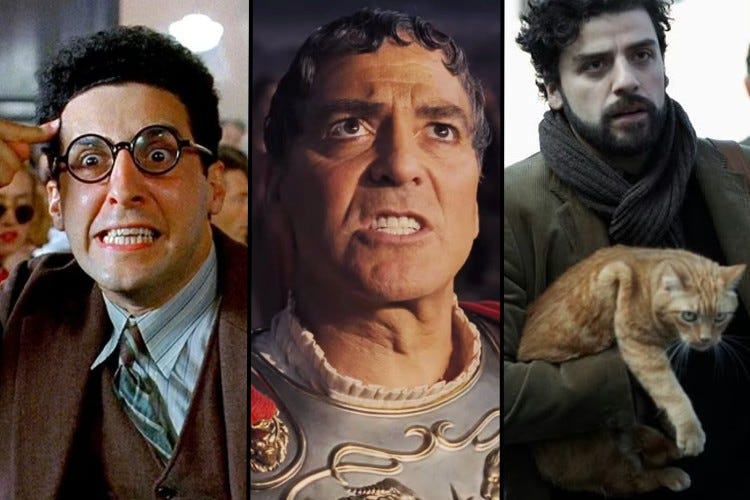
Barton Fink
My takeaway message: Writers who pretend to serve the common man are often full of shit
I really enjoyed this movie about writers who are definitely not me. It was good to think about how some writers — not me, for sure, but others — really struggle to see the world through the eyes of ordinary people. These phonies go on rants about how art should serve the people and play-act being poor, but they’re really just self-absorbed egotists who don’t listen. And that’s an interesting meditation on writers who lack the salt-of-the-Earth esprit de corps that comes so naturally to me.
My favorite joke in this movie is that when Barton thinks he cracked the case — when he get a burst of inspiration and writes “something beautiful” that he calls “the most important work I’ve ever done” — it’s the same fucking thing that he wrote at the beginning of the movie. Movie characters usually go through a harrowing experience and then learn something about life — Barton had a harrowing experience but didn’t learn jack shit. He thinks he’s been enlightened, but he can’t move beyond what he knows.
In the funniest possible outcome, Barton Fink was the toast of the Cannes Film Festival and then bombed at the box office. Which makes the whole project some sort of self-proving commentary on movies and art. The top-performing movie when Barton Fink came out was Terminator 2: Judgement Day, which is a damn good ‘90s proxy for the Wallace Beery movie that Fink couldn’t write. I think that “write what you know” is often bad advice, but maybe writers don’t really have a choice — we are who we are, and though we sometimes imagine that we can live in the common man’s world, we’re just tourists.
Hail, Caesar!
My takeaway message: Movies have worth
This message is pretty explicit — it’s expressed in a monologue at the end of the movie. And I should probably mention that I don’t know if the Coens believe any of these alleged messages — this might not be “We believe the following proposition to be true” so much as “Here’s a notion…whaddya think?”
But I think that the Coens probably do think that movies have worth. They clearly love movies, and their list of favorite movies is full of ones that they must have enjoyed as kids. Hail, Caesar! came late in their careers when they were probably thinking “Did any of this mean anything?” The main character is highly religious and wants to do the right thing but often seems annoyed by the movie business, which — from what I know of the movie business — is how everyone feels all the time. It’s natural to wonder “Is this all worth it?”, and the movie seems to say “yes”.
Inside Llewyn Davis
My takeaway message: Some people need a creative partner
No movie ever made me think “Shit, they made a movie about my life” more than Inside Llewyn Davis. I saw the movie late in 2013, when I was a close-but-not-quite comedian living in New York and gigging at some of the exact same places that Llewyn plays in the movie! MacDougal street is now full of comedy clubs, not folk venues, and in the 2010s, the now-defunct club from the movie was a bar that hosted comedy. It was like someone followed me around with a camera, edited out all the masturbating, and put it on screen.
Except that there was one key difference: I never had a comedy partner. The movie starts shortly after the other half of Llewyn’s folk duo commits suicide, and Llewyn’s most caustic moments — and he is a guy who mostly has caustic moments — come when someone mentions his better half. Llewyn gets offered a spot in a new group and says “no” — it’s suggested that the group ends up being Peter, Paul, and Mary. He blows it with his girlfriend and chooses not to be in his son’s life. It seems like things will never work out for him as long as he’s alone.
I sometimes wonder if the movie was partly the Coen brothers wondering what their lives would have been like if they didn’t have each other. If so, they’re basically saying “I’d be in an endless failure spiral if not for you,” which is sweet. And if they did, indeed, make a movie about how bleak things would be if they didn’t have each other, then that’s just an arthouse hipster’s way of conveying a warm, sunny message.
The World Is Wrong, Vol. 2: Who is "The Hudsucker Proxy" For?

Hollywood executives are basically amateur psychologists with billion dollar budgets. Their job is to figure out what people want and then cram that thing into our orifices until it starts leaking out of our eyes. After Lord of the Rings and Harry Potter

It kinda seems like when people say a piece of art has a "point" they actually mean that whatever it has to say can be boiled down to a short phrase that would fit on a bumper sticker. Thus making bumper stickers the only form of art that doesn't waste your time.
Inside Llewyn Davis just stabbed me in the heart. I think it may have been saying "someone else's life is bleaker than yours and they're being more of an asshole about it." I didn't have a bleak life at the time I watched it, but I did know a little bit about having one. One of my favorite movies of all time.