

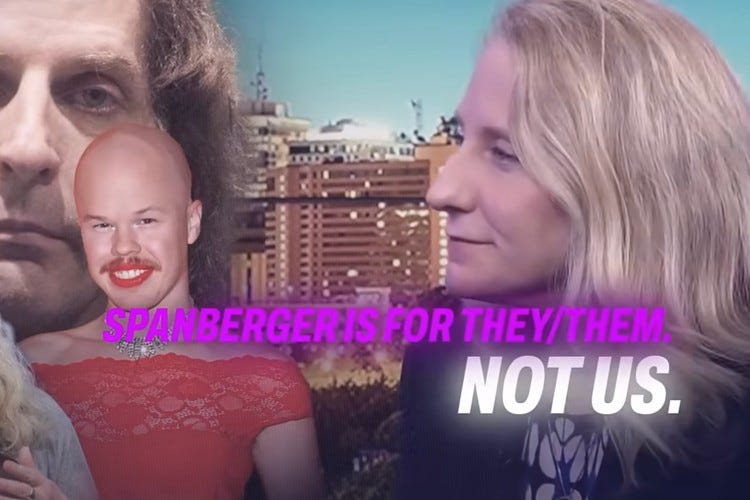
Abigail Spanberger won the Virginia governor’s race by 15 points…that’s a lot. Virginia leans D+4 or 5, Spanberger is a moderate with a functioning brain stem and no Nazi tattoos that we know of, and it’s an off-year election at a time when a president who was given a mandate to lower grocery prices is instead trying to implement The Retarded Reich. I’d say that adds up to about a ten point win. So, where did the five extra points come from?
Well: Spanberger’s opponent had real crazy-lady-at-a-PTA-meeting vibe. Winsome Earle-Sears is a former electrician who attempted the “I’ll fix the government the way I’d fix a malfunctioning 3-pole breaker in a 12-slot Spectra/AV2 switchboard” narrative that I always find corny. Spanberger criticized Earle-Sears for being a culture warrior who was indifferent about DOGE and the government shutdown, which is a criticism that packs a punch in a state where two of the three big population centers (Northern Virginia and Hampton Roads) have a lot of federal jobs (Richmond, meanwhile, is populated by Civil War reenactors and farmers addicted to meth).1 And Earle-Sears did talk constantly about culture war issues — I live in the DC media market, and…my God. Earle-Sears ran more ads about transgender stuff than T-Mobile runs about their network giving you 5G coverage at the bottom of the Mariana Trench.
Why did Earle-Sears’ attempt to replicate Trump’s “Kamala is for they/them” ad fail?2 The Trump ad is the rare case in politics of a signal in so strong that it cut through the noise: Harris allies said that the ad moved voters towards Trump by 2.7 points.3 That’s a lot in a race that Harris lost by 1.5. And it can be tough to mentally square three things that all appear to be true:
Voters care a lot about the economy — it might be the issue that dominates all others (“it’s the economy, stupid”);
The woke focus on culture issues hurt the Democratic brand, and Trump exploited that with his “they/them” ad;
Earle-Sears’ “they/them” ad didn’t work and maybe even backfired.
I think that all these things are true, and I’ll cram my reasons for why I think they’re true into this load-bearing footnote.4 But how can they all be true at the same time? If voters mostly care about the economy, then what do culture war issues like trans women in sports have to do with anything? And how can the “they/them” ad be an asset in ‘24 and a liability in ‘25? I think the answer is: All of these things are about whether voters trust you or not.
The obvious truth that goes unspoken by people who are trying to get votes and/or clicks is that most people don’t know much about public policy. I view this as both self-evident and fine — we all have a job, we all have stuff we know, politics is one of only two areas where people routinely pretend to know how to do someone else’s job (the other area is coaching a professional sports team). But I think that on some level, most people get it: Their job is not to know public policy, their job is to elect someone who knows public policy. It’s like how if I needed a vasectomy, I wouldn’t try to do the procedure myself; I’d try to find a doctor who went to a college that doesn’t have “online”, “fashion”, or “of Suriname” in its name and who doesn’t refer to testicles as “the splooge twins”.
I think it’s also self-evident that economics matters more than, say, trans women in sports. There just aren’t very many trans women, and if most of us had to choose between our daughter losing a swim meet and losing our job and being forced to start an OnlyFans where we let a goat nibble at a sprig of broccoli pinched between our asscheeks, we’d decide that the first thing is not as bad as the second. Also, everyone’s in the economy, while only some of us have to worry about our sports-playing daughter getting Juwanna Mann’d.
The first problem with focusing on culture war issues is that it can make you look frivolous. It’s not just that land acknowledgements, saying “latinx”, and a national conversation about what is the right about to want to fuck the rabbit from Space Jam are dumb: It’s also that they’re off-topic. When politicians mimic or fail to distance themselves from culture war silliness, they look shallow. They come off as frivolous and unprepared to deal with the economic issues that keep us from the livestock-forward OnlyFans content that we all know is just a few missed paychecks away.
The second problem is that a politician on the wrong side of a culture war issue is signaling that they might be loony in other ways. Extreme social views correlate with extreme economic views, so a person trying to have a teenager sent to the Gulag over an insensitive Halloween costume might also be suspected to, say, share Chairman Mao’s belief that the key to economic growth is killing lots of sparrows. A nut is a nut, and convincing voters that you’re merely selectively batshit can be tough.
Earle-Sears’ singular focus on trans issues made her look frivolous. And the zeal with which she jumped into culture war fights — she also had fringe positions on abortion and gay marriage — made her seem like a loon. Spanberger hammered Earle-Sears on affordability issues, and Earle-Sears — unlike Trump — didn’t have the advantage of having played a businessman on TV for 14 years. Trump got something of a free pass on culture war stuff because his brand is “business magician”, despite the fact that his brand should be “business ‘magician’ who fucks up so badly that he has to go to China just to beg them to buy beans.”
All of this is in the trust/values area. Voters need to believe that politicians want the things they want. A politician can signal that they’re out-of-step by being off-topic, or by being on-topic-but-nuts. And when they convince voters that they share their values in one area, people will assume that other values are shared, too — it’s the rare case of voters being rational. Instead of trying to break down a campaign issue-by-issue, politicians should maybe view the whole campaign as a long attempt to convince people that they want the same things.
My Hot Election Take Is That We Probably Didn’t Learn Much

The most click-worthy headline I could publish right now is probably “NEW YORK SUCCUMBS TO MARXISM!!!” Of course, since there are more Beltway Dweebs in my audience than there are sex criminals at a Roblox tournament, “SPANBERGER, SHERRILL PROVE BENEFITS OF MODERATION”
There’s a Simple but Subtle Point in the Latest Analysis of Left-Wing Dysfunction

Democrats continue to soul search after losing a popularity contest to perhaps the worst person in the entire country. This soul searching has led many people to a recent analysis by the Financial Times, which found that — just as you thought — much of the left has turned into a cesspool of cultural weirdness that makes Jonestown look like a model of Enlightenment thought. Here’s a graph — you can almost hear an audible “whhoooooaaaaaa!” as the blue line lurches left.
Did you know that I grew up in Hampton Roads and spent my 20s in Northern Virginia? That explains this joke.
One Earle-Sears ad went so far as to copy the photo collage and tagline used in Trump’s ad.
Annoyingly, I can’t find the methodology behind that claim, and even more annoyingly, GLAAD says that a different study found that the ad had barely any impact. But here’s what I’ve been able to suss out:
The method behind the Harris research seems to be that one group of likely voters was shown the ad, another wasn’t, and the group that saw the ad was more favorable to Trump by 2.7 points. The research GLADD is touting seems to have shown the Trump “they/them” ad to one group and a different Trump ad to another group, and found “no statistically significant” difference between the two groups. Which raises two questions: 1) How effective was the second ad? And 2) How are they defining “statistically significant”? (2.7 points is a LOT in a presidential election!) GLAAD doesn’t say. They do say that 32 percent of the 1,981 people they surveyed didn’t describe themselves as “likely voters”, which might be another cause of the discrepancy between their number and Harris’ number.
Here’s why I think these things are true:
Voters care a lot about the economy. One of the most established findings in political sciences is that when the economy is bad (or perceived to be bad), voters throw out the ruling party. This appears to be true everywhere in the world and was definitely true in 2024, when incumbent parties everywhere did poorly.
Wokeness hurts Democrats and the “they/them” ad exploited that. There is a mountain of research showing that voters think that Democrats are too far left, and trans issues routinely poll as some of the worst issues for Democrats. I also think that the “they/them” ad must have been effective partly because Trump spent a ton of money playing it, and you only do that if your internal research says it’s working.
The “they/them” ad didn’t work for Earle-Sears. She lost by 15 points when I think that she should have only lost by 10. And polling suggested that Virginia voters this year didn’t care much about transgender issues.
Take this coming from someone who has not seen a US political ad in the wild, possibly ever.
Isn't another issue is that, prior to running the "they/them" ad, the Trump campaign successfully nailed Harris to her 2020 position (free sex change operations for illegal immigrants)? It's the difference between throwing haymakers at the air, and having your opponent cornered. In the first place, you counter it by simply not being there/engaging, in the second place your biggest mistake was getting trapped in the first place.
A wise man once wrote that successful comedy requires audience buy-in. The same goes for successful politics.
But more importantly, “Retarded Reich” and “the splooge twins” made me laugh out loud. And “Retarded Reich and the Splooge Twins” could have been the name of a band you would have heard at CBGBs in 1978.