

The tradeoff with driverless cars is clear: They save lives, but they cause some job displacement. Most people who take the “jobs” side of the jobs/lives tradeoff don’t advertise it; unions don’t march carrying “YOU SHOULD DIE” signs, and nobody tweets “Bring back The Terror because I FEED MY FAMILY OPERATING A GUILLOTINE!!! ✊✊✊”. But the tradeoff remains real: The latest data is that Waymos reduce accidents resulting in a serious injury or worse by 94 percent compared to human drivers in cities where they operate. More than 40,000 people die in car crashes in the US every year. Maybe Waymos results won’t scale, maybe their results are somewhat context-dependent, but the potential to save lives is obvious.
Even so, a “people should die so that I can keep my job” movement exists. Incredibly, that movement tries to claim the moral high ground by waving away safety data and emphasizing job losses. This video by More Perfect Union — a progressive media outlet — treats every job loss as a deadweight loss, though technology typically destroys some jobs and creates others. The video also makes treacly emotional appeals and leans heavily on music that was probably listed in iStock as “Ominous Progressive Media Theme 47-D”. And ironically, this video from a progressive source (it was founded by Bernie Sanders’ former campaign manager) treats Uber jobs as indispensable, though it was only last year that Uber was to Online Lefty Nutcases what The Odyssey is today to Right-Wing Rage Fetishists.
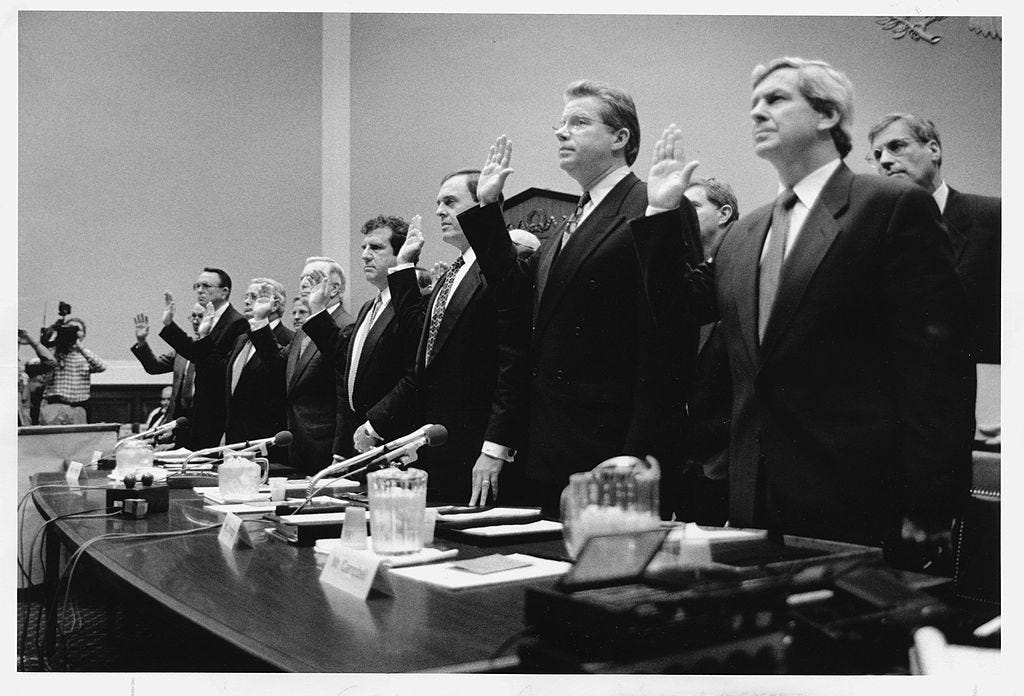
Driving carries risk, but we do it anyway.1 Smoking also carries risk, but people do it anyway. Of course, they do it a lot less than they used to: Smoking is down by about two-thirds since the ‘60s. That drop is mostly because people now know that smoking is deadly, and a little because smoking is now banned everywhere except for Wilco concerts and one cornfield in Ladner, South Dakota. The tobacco industry fought hard to keep smoking common, famously defending their product in a high-profile hearing — it was the most gripping Senate hearing of the ‘90s that didn’t involve a discussion of Clarence Thomas’ pubic hair. People now consider Big Tobacco’s arguments a PR disaster, and nobody calls for re-popularizing cigarettes, though I’ve noticed that pro-tobacco arguments back then map fairly well onto anti-Waymo arguments today.
Most people don’t think of tobacco use as a jobs issue, but most people aren’t from places that grow tobacco. I, however, am: I grew up mostly in Kentucky and Virginia. In those places, anti-smoking campaigns were treated as a Bolshevik plot to destroy the local economy. Smoking bans were resisted; well into the 2000s, you’d come back from a restaurant in Norfolk smelling like you’d been at a mafia-run poker game. Generally, smoking was treated as patriotic-bordering-on-noble, and anti-smoking campaigns were thought of as overbearing Yankee moralism — who were they to tell us how many cartons per day our kids should smoke?
Data was waved away. Sure, research showed that nicotine is addictive and tobacco is a carcinogen, but the Nazis used “research” to show that the Aryans are the master race — you’re not a Nazi, are you? Smarter idiots would dismiss the damning studies by noting that correlation doesn’t prove causation, which is true, but it’s also true that correlation sometimes is due to causation, and that was true with smoking and cancer. The reality was that people were scared, they felt that their livelihoods were threatened, so they defended an industry that was causing preventable deaths. And what ultimately happened is that smoking did fade away, local tobacco production did plummet, but there was no discernible effect on the local economy.
And, frankly: I think Big Tobacco had a better argument than the anti-Waymo people, because the anti-Waymo crowd are trying to ban access to a service, while the tobacco companies were merely trying to preserve an individual’s God-given right to assault their organs with tar. Cigarettes aren’t banned, but Waymo’s opponents are trying to get the cars off the streets. And there’s a big difference between giving someone information so that they can make a different choice and precluding someone’s choice due to a misguided sense of how jobs are created and preserved.
Nobody today argues that we should bring back dangerous and or deadly practices in the name of “jobs”. Removing seat belts from cars would create jobs at hospitals; putting cocaine back in soft drinks would surely boost productivity, especially in the Terrible Screenplay industry. That doesn’t mean we should turn back the clock. And though every technology affects jobs, the solution is to help people manage the transition, not to return to the Stone Age. And when a technology saves lives, the switch should be accelerated, not stopped. People today laugh at Big Tobacco’s cynicism; they’re seen as corporate villains only slightly more cartoonish than Mr. Burns. I think that the anti-Waymo movement might look similar in the future.
Is KitKat the Modern-Day Horst Wessel?

In 1930, a German man named Horst Wessel was shot and killed by a communist. Wessel was part of a Nazi paramilitary group, and Joseph Goebbels immediately recognized his death as a propaganda opportunity. Goebbels published an effusive eulogy for Wessel in the Nazi press and personally attended the funeral, which he claimed was attended by 30,000 people (so: probably a few dozen folks including funeral home staff). When the Nazis took power, they made a song about Wessel the co-national anthem along with the song commonly known as
Teamsters Fight Back Against the Horrible Specter of Fewer Traffic Deaths

A self-driving car company takes initial steps to introduce its vehicles to a city. Residents — led by the Teamsters Union — push back, arguing that self-driving cars are unsafe. This happens even though the most comprehensive, peer-reviewed study on the impact of that company’s impact found that their cars dramatically reduced all types of crashes, sometimes as much as 96 percent. Despite data suggesting that driverless cars could reduce injuries and fatalities, city council members appear to side with the Teamsters, using the bizarre argument that the safer cars threaten safety.
In case anyone was wondering: Yes, I drive. And no, I don’t smoke.
Waymo's data is peer-reviewed: https://waymo.com/blog/2025/05/waymo-making-streets-safer-for-vru/
And the results are so stark that even if there were problems with data collection that substantially altered the results (and maybe there are!), the point would still stand. I would still write this article if serious accidents were 20 percent less likely instead of 94 percent less likely.
I am fascinated by how the anti-smoking crusade has morphed into anti-vaping. I haven't smoked in decades (being old and having survived the 60s Mad Men era) and have never vaped. But as I understand it, vaping is just consuming possibly helpful and non-dangerous nicotine in a water vapor. None of the tars and other cancer-causing elements. But somehow, just because vaping looks kinda like smoking, it must be shamed and banned. I hear one argument against vaping may be that it is a "slippery slope" to smoking (reefer madness!) . . . however, it seems more likely a stepping stone away from smoking for many. But the arguments against vaping, as with autonomous cars, have nothing to do with rationality.