

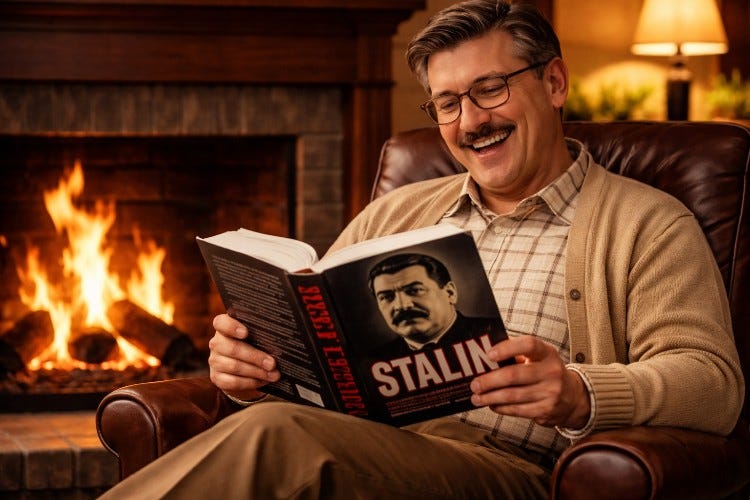
We all know that past a certain age, men just want to sit and read books about history. I remember when my dad went through The Change; I came home from school one day, and instead of being in the driveway shooting baskets and listening to Dire Straits, Dad was inside reading a book about the Korean War the size of a cinder block. At age 45, I’ve now undergone a similar shift: I now seek out information about the Italian invasion of Ethiopia the way 15 year-old me sought out topless photos of Cindy Margolis.
I used to wonder what that change was about. Now I know what it’s about, and I’ll tell you after I talk about Trump’s misadventure in Iran. Last night, Trump basically announced that he’s going to give up soon. The Iranian regime is still standing, they still have their nuclear material, and they’re still funding their terrorist proxies. We may have actually made things worse, because the regime can brag about standing up to the Great Satan and Li’l Satan, which is the adorable epithet they coined for Israel. Iran also now knows exactly which pressure points to hit if there’s another conflict. No matter how much Trump argues that Iran’s un-obliterated nuclear program has been re-obliterated, and that the regime has changed because we went from Ayatollah H.W. Khamenei to Ayatollah W. Khamenei, comparing last night’s remarks to Trump’s remarks at the beginning of the war makes it clear that he failed to achieve his goals.
Was there any way that Trump could have known that this war was a bad bet? Yes: He probably would have known that if he studied history. Trump’s not a student of history, as proved by the fact that he made “bomb them back to the Stone Age” the key phrase in last night’s remarks, even though that phrase comes from an air campaign that famously failed to achieve its strategic goals. If Trump had spent middle age consuming biographies of Churchill like a panda consumes bamboo the way he was supposed to, he might have avoided these mistakes. Especially the key mistake, which was to listen to what is probably the most common disastrous argument in history: “This war will be quick and easy!”
The most famous expression of this tragic optimism is surely Kaiser Wilhelm telling his troops in August 1914: "You will be home before the leaves have fallen from the trees." I always wondered if he later said “Germany’s forests are mostly coniferous, so we really have needles, not leaves, so technically I wasn’t wrong.” If he did say that, it’s not recorded — what is recorded is that Europe fought a war so terrible that even in an age when people regularly died of mule kicks and ingrown toenails, people were shocked by the war’s awfulness. Of course, in Kaiser Wilhelm’s defense — which aren’t words I love typing — he was far from the only leader suckered by hawks who convinced him that war would be quick, painless, and awesome.
Here is a by-no-means-complete list of conflicts that ended up being far longer and more costly than their architects bargained for:
The Hundred Years’ War (obviously)
The Thirty Years’ War (which seems less bad after The Hundred Years’ War but was still really bad)
Vietnam
Iraq
The Punic Wars
The American Revolution (from Britain’s perspective)
The Russo-Japanese War
The War of the First Coalition
Napoleon’s invasion of Russia
The Mongol invasion of Japan
Italy’s invasion of Ethiopia (first time)
Alexander the Great in Afghanistan, Britain in Afghanistan, Russia in Afghanistan, the United States in Afghanistan, and any other wars in Afghanistan that aren’t coming to mind right now.
There are always, always people trying to convince a leader that he can have conquest and glory at a low price. They portray the gains from a conflict as certain and the risks as miniscule. Every story that ends with “so they used the frozen corpses of their comrades to build a barricade” begins with someone in the capitol saying “It’ll be so EASY!”
A history buff would have been extremely wary of Netanyahu and various Bush-era holdovers who insisted that this war would be quick and easy. Not every conflict is a quagmire, but many of them are, especially when they take place on another country’s soil. Trump’s failure to understand the difference between assassination and regime change and his lack of a contingency plan for Iran closing the Strait of Hormuz indicate that he didn’t think this war through beyond the first strike. His ignorance led him to step on the same rake that has been stepped on millions if not jillions of times throughout history.
Which brings us back to your dad: He was into history because it taught him lessons that were useful in the present. Your dad reached a point in life where he had to make big decisions, and he possibly felt a bit overmatched, so he looked for pointers from people who had to make decisions in the past. Not every lesson from history is transferable — I’m not sure how much the Boxer Rebellion tells me about whether rooftop solar is a sound investment — but many of them are. “Don’t fall for ‘this war will be quick and easy!’” is really just the geopolitical version of “If it sounds too good to be true, it probably is.” History contains endless lessons about character and social dynamics that transcend place and time. Dads like history because they’re looking for answers, and history is one of the only places that has them.
And Trump is what your dad would have been like if he didn’t have the curiosity to search for answers. If your dad had concluded that he already knew everything, and was comfortable being a world-historic jackass leaving a trail of chaos in his wake, then wouldn’t have ever thought “What does Magellan’s voyage tell me about Roth IRAs?” Whether your dad knew it or not, his history obsession was a sign that he cared about getting things right. And the middle-aged guys who don’t tie into a 2,000 page biography of Charlemagne immediately after getting off of work on Friday are the ones you should be concerned about.
Russia Has Had Its Dick Caught In Basically This Same Beehive Before

***NOTE: I’m not a historian or expert or person who should be talking about anything, ever. I read things, summarize them, and add jokes — it’s sort of a Doris-Kearns-Goodwin-meets-Henny-Youngman-if-neither-had-talent situation. Virtually everything in this article is taken from

You listed Britain in Afghanistan once. They should be listed 3x
I mean, he doesn't even need to read history: Russia's "special operation" in Ukraine is RIGHT THERE, going on year five, a million Russian casualties and counting. It's a pretty good example of what happens when Plan A is "Oh they'll collapse quickly, don't worry about it" and then there is no real Plan B.
Of course, this is the same man who seemingly takes it at face value when Putin tells him Russia is "winning" this war, so maybe it's no use.