

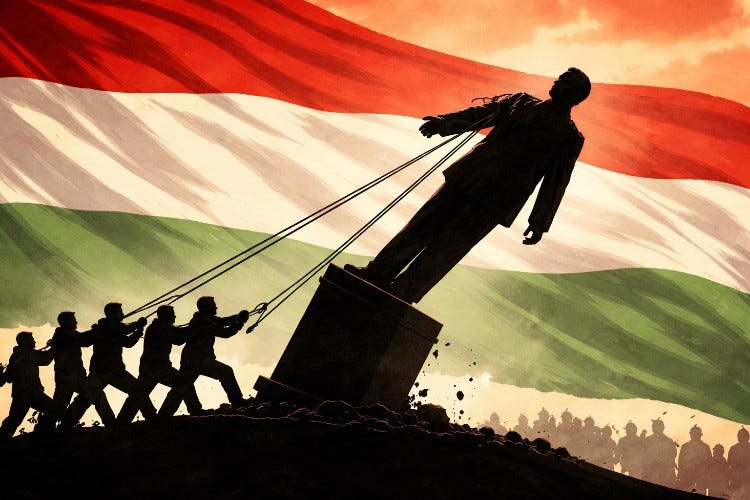
Orbán is out in Hungary. I’m happy, because I dislike Orbán’s brand of ethno-nationalist illiberalism, and because I’m tired of typing that goddamned “a”-with-a-li’l-hat-on-it in Orbán’s name (if you’re on Windows, it’s “NUM LOCK + ALT + 0225 + SHIFT + WINDOWS + CONTROL”, hold down for 70 seconds). Orbán’s ouster also seems like a good time to reflect how badly the big theory of political change from ten years ago has fared.
Circa 2016, people thought that we might be witnessing the beginning of a populist authoritarian wave. Trump won in the US, Brexit passed in Britain, the Law and Justice Party was in power in Poland, and Orbán was making his illiberal intentions known. The rule that I learned in college — that when a country becomes an established liberal democracy, they don’t go backwards, sort of like how once you start getting your groceries delivered, you’ll never set foot in a grocery store again — seemed wrong. Liberal democracy was maybe not the end of history. And I was an acolyte of this thinking — if this piece is a dunk on anyone, it’s a dunk on my eternal bête noire: me from the past.
One thing that made the “rising authoritarianism” theory compelling was the presence of a plausible instigating event: The advent of social media. The story went like this: Social media bypassed gatekeepers and democratised information, which empowered fringe elements that had been shunned by establishment types in politics and media. It also gave politicians who speak the people’s language a direct line to their audience. It empowered the common man and reminded us why most framers of Western constitutions greatly feared the common man, whom they considered smelly, ignorant, and more than ready to burn witches or murder Jews if they thought it would increase crop yields by even a miniscule amount.
The theory had logic, but a global shift towards populist authoritarianism hasn’t happened. Brexit is unpopular, the regimes in Poland and Hungary have been voted out, and Trump would be out if Kamala Harris hadn’t responded to a question about using taxpayer dollars to fund gender reassignment surgery for anyone anywhere in the world (or whatever the question was) with: “Sure”. No new Western governments have hopped on the authoritarian bandwagon in the past decade. Social media is still with us — and it has not morphed into a Lincoln-Douglas-style long-form tête-à-tête, to say the least — but what looked like the beginning of a wave now looks like more of a self-contained ripple.
So, what about the theory was wrong? To my mind, definitely the notion that people were becoming ideologically right-wing. We really need to drop the idea that most people are ideologically anything — they’re just not. John and Jane Average Dipshit are not crusaders, they don’t want to be foot soldiers in your silly little Socialist Revolution or corpses in your re-conquest of Christian civilization; they want a better, simpler life, and also for their enemies to be killed by hornets, if possible. Political types ascribe to grand, high-falutin theories, but regular people who have a shot at experiencing joy or sex at some point in their lives do not. So, we political types need to stop imagining that every tremor in the political landscape is a harbinger of a seismic shift that will lead to permanent victory for one ideological faction or another.
But the political shift that probably did occur involves immigration. Though social media did not suddenly turn people into acolytes of Nietzsche and Carl Schmitt, it did make nativist politics far more potent. Old Media would deem, say, video of a random immigrant being an asshole on a bus not newsworthy, but social media personalities will circulate that video all the way to the bank. And a politician whom establishment types would have laughed off as a xenophobic loon can now take their case straight to the masses. These changes combined with the fact that…ya know…there’s a there there — you won’t find me arguing that Western governments deserve five-star reviews for their handling of immigration — are why basically every liberal democracy has a noisy anti-immigration party. Centrist parties need to get with the times and neuter the potency of anti-immigration politics. That was the policy of incoming Hungarian prime minister Péter Magyar, a man whose nationalist credentials are surely helped by the fact that his name — if he was British — would basically translate to “Johnny Anglo-Saxon”.
I should probably get “VOTERS DO NOT UNDERGO BIG IDEOLOGICAL SHIFTS” tattooed on the inside of my eyelids. Most voters are practical, not ideological — their concerns are typically material and first-order. They also seem to periodically get bored with their leaders — rarely does any party anywhere in the world enjoy more than a decade in power before voters say “Nah, fuck that” and elect anyone else. Permanent ideological shifts basically never happen. And the good news is that the ideological conquest of the Western world by illiberalism that many of us feared a decade ago has not happened. The weird news is that any of us ever thought that it might.
I See a Way for Democrats to Fumble Away Their Sudden Advantage on Immigration

Trump has gone too far with immigration enforcement. Though no-one could have guessed this, it turns out that most Americans don’t like groups of masked men roaming the streets harassing and shooting people with impunity. Of course, a third of the country is totally into it — no matter how extreme Trump’s actions get, some people have nothing to say about our rapid slide into authoritarianism other than “WHEEEEEEEEEEEEE!!!!”
Why Doesn't the "Trump is a Fascist" Stuff Land?

The list of things a person needs to do to be an American in good standing is pretty short. You need to have seen the original Star Wars. You have to either like baseball or think cricket is stupid, either is fine. On July 4, you have to grill something,
You touch on this, but I would go further and say that many people are easily swayed by emotion-driven arguments, regardless of the merits of the argument. And if you're going to just flit from one emotional flashpoint to the next, there's no way you can be ideologically consistent.
There's a tendency to always think in terms of progress towards an end state. Evolution: some creatures are more evolved than others. Morality: there is an "arc of history". Politics: the coming revolution. Etc.
This makes sense if you're a religious person who believes in an interventionist god, but if you're a deist, or secular, than this is a truly weird position to take. This often comes up in discussions around things like the Holocaust (I bring it up because today is Yom HaShoah), the idea that "it couldn't happen here" (although that is happening less now that people are looking to point a figure and say it is happening in Israel, a truly vile and historically illiterate claim). There were some truly evil people in Nazi Germany, but the majority of people were ordinarily evil, just your standard, everyday antisemites. It could "happen here", and if you were around then you probably wouldn't have been a righteous among the nations (and anyone who is sure they would have been, I'm more likely to think they would have been one of the Nazis).
Liberal democracy is not a stable point, nor was it thought to be by your founding fathers when they established America. "the tree of liberty must be refreshed from time to time with the blood of patriots and tyrants". This is an acknowledgement that illiberalism is a constant force that will always threaten to destabilise liberalism. (who is the patriot and who is the tyrant is an exercise left to the reader).
Anyways, my point is, things just happen. There's no "intelligent designer" for anything on a macro scale, not for evolution, not for politics, not for morality.