

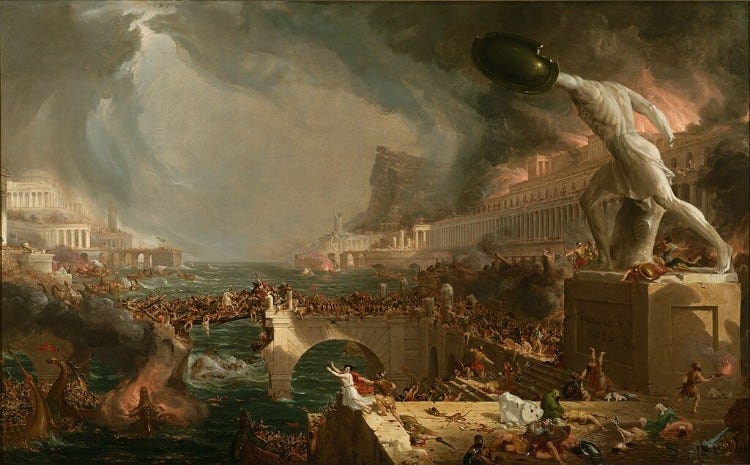

Here are some charts that most people probably assume are hallucinated bullshit, like when you ask AI to design a house and it puts the toilet in the middle of the kitchen:
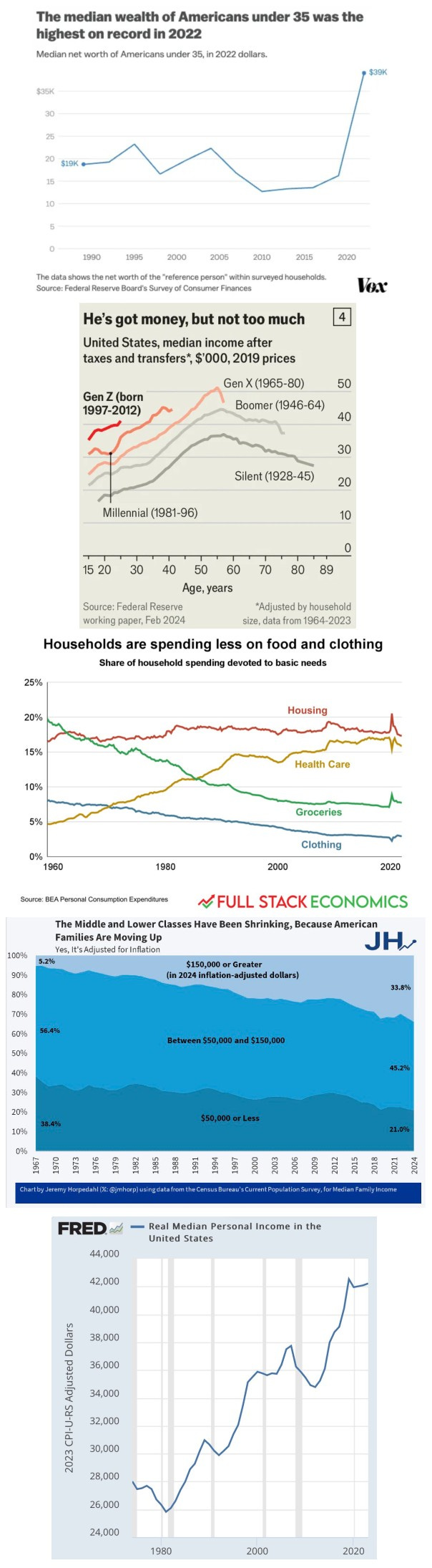
These charts are real…but how can they be? We’re constantly told that we’re living in tough economic times — I hear that the middle class has been “hollowed out”, and that you have to perform sexual favors on your local Albertson’s manager just to buy a dozen eggs. Generation Z — the story goes — is beyond screwed; the only jobs for them will be OnlyFans modeling and gig work delivering bubble tea to robots. These beliefs are so widespread that in a recent conversation between Sam Harris and George Packer — in which they spoke intelligently on many topics — the notion that Gen Z is struggling economically went unchallenged. It was like hearing two physicists discuss the finer points of quantum field theory and then reveal that they think that thunder is caused by a giant farting dragon in the sky.
Though the story of economic implosion isn’t true, it feels true to many people. Why? Matt Yglesias recently offered eight hypotheses — here they are:
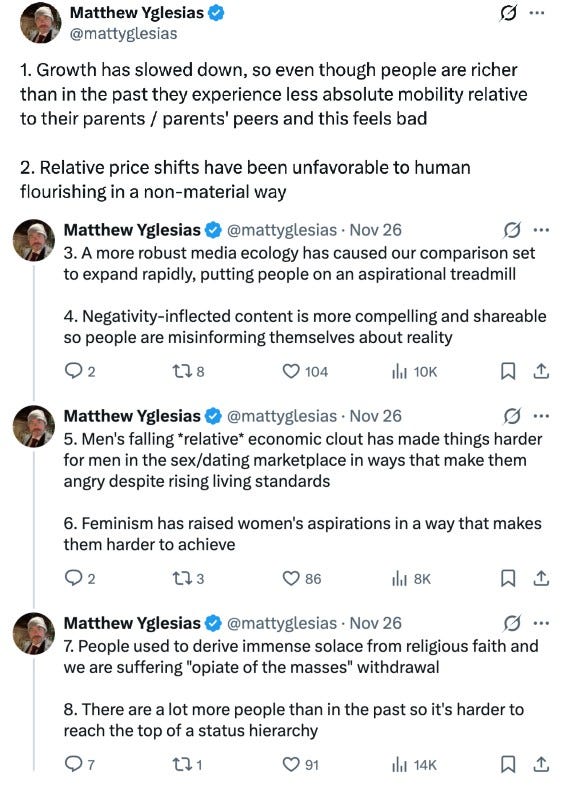
My guess is that all eight of these things are at least a little bit true. They all stem from the fact that being human is hard, and there will probably always be a gap between what we have and what we want. Maybe the only people who have freed themselves from the constant urge to want more are Buddhist monks who only desire a bowl of rice and freedom from harassment by the Chinese government, and who will still be happy when they only get the rice.
But I think that one of Matt’s hypotheses is far more true than the others: Hypothesis #4, the one about how negative economic coverage plays better than positive coverage. Doomer narratives resonate with the public, so people in journalism and politics flog those narratives like a sadist jockey. And I think that people have a dim view of the economy mostly because they constantly hear that we’re living in an era that makes the Irish Potato Famine look like a make-your-own-sundae party.
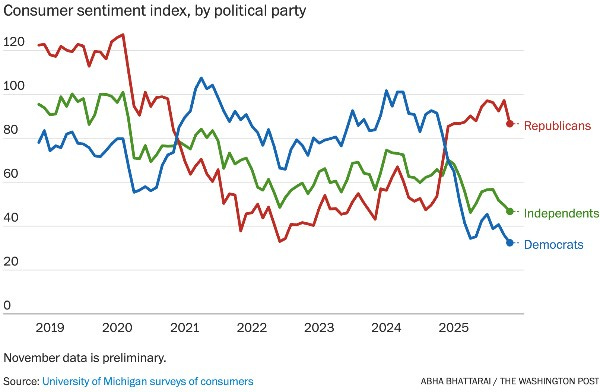
The message of every opposition political campaign in human history is “things suck”. In recent years, campaigns have exploited the extreme elasticity of the word “things” — if there are a million things in the political universe, and two of them suck, then it’s technically true that “things suck”. It’s also true that focusing on less-than-optimal parts of the economy puts your opponent in a trap: If they say “Okay, yes, that sucks,” then they’ve validated your narrative, and if they say “You’re cherry-picking, things aren’t that bad,” then they look like callous fat cats telling laid off factory workers to eat cake and die. Some doomerism is just political opportunism, as shown by the fact that political partisans magically change their view on the economy every time the White House changes hands:
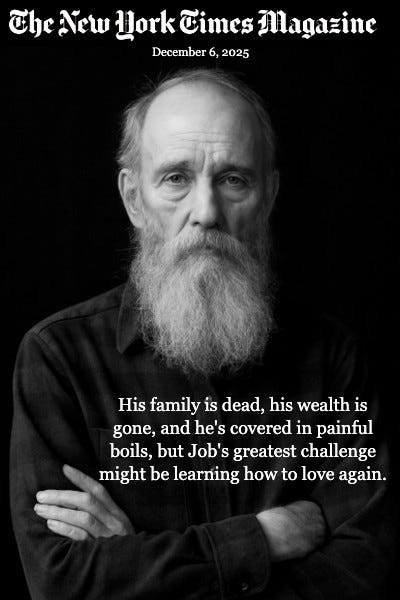
It’s also true that journalism naturally favors the negative. There are several sayings that capture this: “If it bleeds, it leads,” “a truck not-on-fire isn’t news”, and “holy shit have you seen Fox News’ ratings — they’re getting rich scaring the piss out of old people.” Michael Stipe once observed that it’s hard to write a happy song, and in the same way, it’s hard to do journalism about things going well. And that’s exponentially more true in the field of human interest journalism, where the task is to find the unluckiest bastard under the sun and tell his story beneath a gritty, black-and-white photo of him looking brave.
Partisanship favors doomerism, media favors doomerism, and partisan media kicks things into overdrive. I visited my in-laws for Thanksgiving and got my yearly dose of MSNBC — actually, “MSNOW”, since NBC apparently decided that the Chicago P.D. folks shouldn’t have to answer for whatever Rachel Maddow says — and that network is hitting the cost-of-living talking points hard. I actually saw a segment where they reported that people at a gas station would like lower prices — I think it was on the show No Fucking Shit with Stephanie Ruhle. People always prefer lower prices for everything, that’s been true since a caveman tried to charge three shrunken skulls for a wheel, but now partisan media publish opposition talking points and some people think that’s the news.
Incentives to make things seem as bad as possible are everywhere. And I haven’t even mentioned socialists, whose worldview is based on capitalism being unviable, and who gnash their teeth every time another million people escape poverty. The habit of emphasizing bad news and downplaying good news creates a media environment that makes David Lynch movies look sunny and upbeat. And I think that probably fuels economic doomerism more than any other factor.
Where’s This Shadowy Cabal of Business Elites I Keep Hearing About?

Tomorrow, Trump will implement a major new round of tariffs. He’s calling it “Liberation Day”, probably because he’s going to liberate your 401K from having any value. The plan is largely the brainchild of Trump — who really puts the “child” in “brainchild” — and Peter Navarro, who is …
IMBW Audio: Thoughts on That James Carville Article

I Might Be Wrong is a reader-supported publication; I don’t sell ads or do any of the things that I should probably do. To support my work and receive new posts, please consider becoming a free or paid subscriber. Paid subscribers get twice the stuff, my thanks, and a general feeling of superiority.
My personal theory about where a lot of doomerism comes from has two parts:
1) Whatever level of wealth you grew up around feels normal to you, and most people seem to think they grew up "middle class" even if, upon inspection, their parents obviously had a 95th percentile income
2) If your parents have a >50th percentile income growing up, your relative position will be lower than theirs on average. If your parents have a 95th percentile income growing up, your relative position will be much lower than theirs on average unless you go to medical school.
The combination of these two facts means that a bunch of people who grew up pretty well off can only afford a middle class lifestyle rather than a high-upper-middle class-in-NYC lifestyle, and to them that feels like poverty. They'll never be able to afford the kind of house their parents owned in the kind of neighborhood they grew up in.
One of the major tells that this is going on is the big focus on student loans. A lot of people don't go to college, and if your parents are genuinely middle class you almost certainly got in-state tuition at a state school, which is typically less than $15k per year assuming no scholarship or financial aid. All the doomers talking about how tuition is $40k per year and you need to take out $80k of student loans to get a degree don't seem to even be aware that attending a state school is an option, never mind attending a community college and then transferring to a state school.
For an extreme example of this dynamic, I once had somebody from China whose parents paid for them to attend Georgetown for grad school tell me that they grew up "very poor" in China because a lot of the kids at the elite prep schools they attended were richer than them.
All that to say I think doomers are largely the bitter middle class children of upper middle class parents.
I think the missing piece here, though, especially regarding Gen Z, is housing affordability. When my 72 year old dad was a young man in Dallas, he could buy a single family home in Dallas for about his annual salary, maybe a little more. Almost no one can buy a house anymore for 75,000, and rents can be just as punishing. I agree media doomerism goes too far, but affordability is huge for the kids today.