


There’s a debate happening over whether Democratic Socialists of America are socialist or communist. Both DSA folks and their critics seem to agree that the distinction is important; few seem compelled to dismiss the argument as a pointless slap fight over semantics. Many DSA folks, in particular, seem to view the “communist” label as libelous right-wing slander, and I’m going to give those people the benefit of the doubt and assume that they’re not the same people who show up at DSA meetings to express their abiding love for communism.
And now for a confession: I don’t know what the hell anyone on either side of this argument is talking about. My understanding of “socialism” and “communism” render the whole dialogue gibberish. I feel like a dog listening to a conversation between humans: I’m tilting my head and staring intently because I know that talking is happening but I’ll be damned if there are any words in there that I recognize. And my confusion only deepens when I confront the fact that I really, really, really don’t know what the hell socialism or communism have to do with Palestine.
Before I get to the crucial question of what other people think these words mean, here’s where I’m at: I was taught1 that communism evolves from socialism. To Marx, communism — sometimes called “full communism” even though that’s kind of like saying “totally dead” — is the hippified state of nature that emerges after capitalist structures have been dismantled. This is Marx’s “New Man” stuff: “Today he is a fisherman, tomorrow he is a painter” — you know, that hilarious bullshit. Socialism, to Marx, is the intermediate phase required to move from capitalism to communism. In that intermediate phase, the government seizes the means of production, and once capitalism is dismantled, human behavior fundamentally changes; the government becomes unnecessary and eventually withers away. True or untrue, it’s an elegant theory, even if scores of dead do get kind of “yada yada’d” out somewhere in the middle.
So to me, when people say “I’m socialist, not communist,” I hear: “I support the hellish purgatory that Marx himself called ‘the dictatorship of the proletariat’, not the beautiful utopia that Marx thought would make the oppressive intermediary period worth tolerating.” Seems weird! Kind of like saying “You know what I love about corn? The HUSK!”
But obviously that’s not what people mean when they call themselves socialists. So, what do they mean? I’m not trying to convince anyone that my definitions are correct; I want to know what people mean when they apply these labels to themselves and others. It seems that there are a few interpretations.
Possible meaning #1: Communism is socialism, but, like…MORE
Communism is associated with the color red, and we sometimes call socialists “pinkos” (especially if “we” are a cop in a ‘50s police procedural). Do those colors represent the difference, i.e.: It’s just matter of degree? Are you a communist if you want jackbooted thugs to drag capitalists from their factories and have them pelted with rocks in the street, but you’re a socialist if you want medium-sized guys in Ugg boots to cajole capitalists onto the sidewalk where they will be lightly beaned with tennis balls? This seems to be how some people think.
If true, then the socialist/communist labels are just the far edge of the semantic hierarchy that’s emerging on the American left. In the same way that tabasco sauce comes in “medium”, “hot”, “blazin’”, “hellfire”, and “rectal Hiroshima”, some people’s labeling system seems to basically be this:
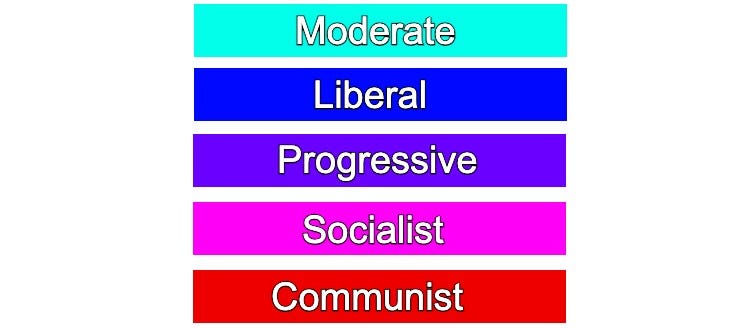
Possible meaning #2: Socialism means progressive taxes to fund a generous social safety net; communism means state control of business
This makes logical sense, though it’s basically the opposite of what “socialism” means in classical Marxism. Consistent with the sense that communism represents something beyond socialism, this definition identifies a step that communist would take that socialists won’t. Which is a reminder that unless you are the most extreme extremist in the leftist galaxy, someone will be around to call you a corporate pantywaist.
What confuses me about this definition is that it seems to render the word “socialist” completely unnecessary — doesn’t this definition simply describe mainstream Democrats? To wit: I support progressive taxes to fund a generous social safety net, I’m about as popular with socialists as water slides are with cats. This definition has the same matter-of-degree dynamic as meaning #1, but in the other direction: This time, socialists are Democrats, except…ya know…moreso. And I know that socialists like to pretend that they’re the only people who ever thought to subsidize health care or food, but that’s actually been a standard belief for pretty much every Democrat for the past hundred years.
Possible meaning #3: Socialism is democratic; communism is authoritarian
This seems to be the fault line for many people: Socialism is viewed as compatible with democratic governance, but communism is ipso facto authoritarian. And for sure, every government that has ever adopted the “communist” label has been authoritarian. Meanwhile there are nominally socialist parties all over Europe who are indisputably democratic, as proved by the fact that they take their frequent-and-often-brutal electoral ass-kickings with admirable aplomb.
But, again, the presence of other words confuses me: If socialists are definitionally democratic, then why do many people call themselves “democratic socialists”? That’s redundant — it’s like calling yourself a “celibate Civil War reenactor”. And socialists have huge debates — decades long debates, in fact — over whether socialism can or should incorporate liberal principles like free speech and elections. I don’t understand how that can exist within the “socialism” label if socialism implies a belief in liberal democracy.
So…thoughts? The floor is open, and on a non-paywall day, so I encourage the sane people to chime in so as to balance out the irradiated mutants who are sure to wander in. I think it’s unlikely that this debate will be settled to the satisfaction of anyone involved, but maybe — just maybe — I might at least figure out what the hell people are talking about.
Why Do We Call Not-Socialism "Socialism"?

If you’re looking to become much dumber very quickly, I highly recommend this The Problem with Jon Stewart segment on socialism. And if you’re thinking “I would like to be dumber, but I have plans to have a railroad tie fired through my brain like Phineas Gage
Capitalism Has a Brand Problem

Let’s get the blood pumping today with a deep-fried, smothered-and-covered moron: Italian economist Clara Mattei.
I took several courses in college that involved Marx and/or later interpretations of Marxist thinking (e.g. Lenin, Mao).
I have for the past five years theorized that most self-described socialists just think of a regulated market with a welfare state as socialism and I have yet to be proven wrong
Your definition of socialism as being the waypoint between capitalism and communism is, objectively, the correct one. It's how all of the people who created socialist states in the 20th century would've defined the term. It's crazy-making how self-identified Millennial and Gen Z "socialists" react with outrage when you point out that whatever the hell they mean by that term (they often don't seem to know), they're using it incorrectly. Nordic-style welfare capitalism is... Nordic-style welfare capitalism. It's not socialism. Stop calling it socialism.
For a lot of Millennial socialists, "socialism" seems to be the political label they apply to their generational resentment of Boomers; Boomer lefties are Democrats, but Millennials hate Boomers, so Millennials are "Democratic Socialists." Gen Z socialists think the garbled definition of socialism meaning "public roads" that they saw on Tik Tok sounds cool. It's the Boomer and Gen X socialists you need to watch out for: they're old enough to remember the Soviet Union, so tend to understand what the term has historically meant, and use it to describe themselves because they yearn to liquidate certain classes of capitalist pigs.