

I rarely see retro trends coming. I was blindsided by the ‘90s swing revival, and I had no idea that cool kids in the 2010s would sport facial hair that made them look like the shortstop for the 1881 Akron Stillbirths. My nephew wanted a film camera for Christmas, there’s a market for cassette tapes — what’s old sometimes becomes new again, which means there’s a non-zero chance that my retirement could be funded by my collection of California Raisins figurines.

Surely the most surprising retro trend is America’s sudden turn against technology. Recently, the dialogue around data centers has come to include skepticism of electricity, which happens to be a technology older than matches. Even so, journalists and politicians are indulging concerns about the effects of transmission lines — here’s a clip of an aspiring congressman talking to a lady who doesn’t want a power line buried on her property.
I don’t want to dunk too hard on this lady, partly because I’m 60 percent sure she’s my great aunt. But a reasonable response to her “radiation” fears would be to pick up the coffee pot on the table and say “What do you think powers this thing — fucking elves?” But instead of doing that, once-and-possibly-future-congressman Tom Perriello nodded like a bobblehead doll on a cabbie’s dashboard and then produced this video, which — of course — required God-knows-how-many data centers. This video makes me wonder what fearmongering can’t be crammed into the little-guy-being-trampled-by-the-big-guy narrative. Could you make people afraid of bluebirds? Start a movement accusing grapefruits of witchcraft? Convince people that they’re about to be attacked by their socks? I feel like literally anything is possible once “electrical radiation killed my horse” is on the table.
Fear of electricity ignores a few hundred years of human experience, but other people seem determined to ignore a few thousand years. Yesterday, author Paul Vigna argued in The New York Times that America might solve its debt problem by following the lead of Enmetena, a Mesopotamian king from 2400 B.C., who issued an edict that cancelled virtually all debt. Which is a hell of an argument: The Mesopotamians did it, so, logically, it must be good! Vigna is boldly moving the Overton window by floating the idea of rebooting ancient Mesopotamian policies, which, I’ll point out, included human sacrifice, slavery, arranged marriage, witch dunking, child abandonment, and the practice of trying to divine the future by examining the organs of dissected animals. But maybe defaulting on their debt was their one good idea!1 Though, honestly: I think the practice of looking at your debt and thinking “I’m not paying that shit” is more than 4,400 years old.
Modernity is being rejected all around us. “RETVRN” memes romanticize a past that never existed. Much of the population has turned against vaccines. The president pursues a trade policy modeled on the McKinley administration. People are nostalgic about the past, angry about the present, and utterly terrified of the future.
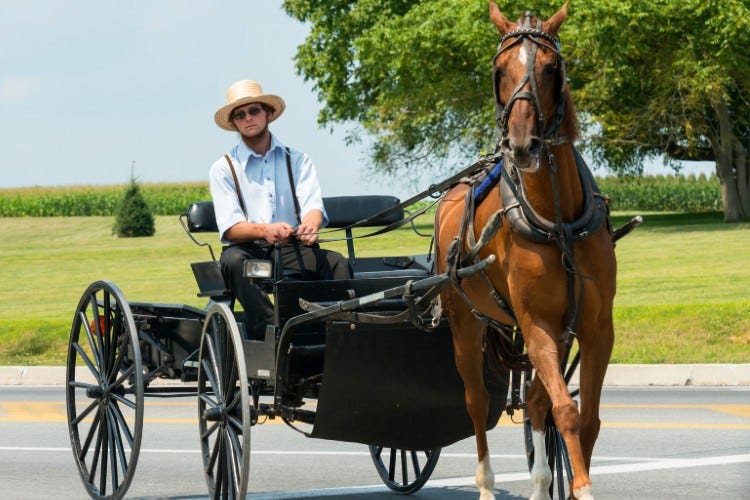
And yet few join the group that acts on the principles of the anti-modernist movement. I speak, of course, of God’s favorite road hazard: The Amish. The Amish don’t use any of the technology associated with data centers or evil electricity. Many don’t believe in lending money with interest. They’re thoroughly untroubled by data theft, energy prices, or those dastardly, scheming “tech bros”. They’re completely unbothered by any of the sources of this anti-tech, populist moment.
And I hope people realize: You can just go be Amish. Any of us could do it today — there is literally nothing stopping anyone from giving up the rat race for a wholesome life of butter churning and becoming physically aroused by especially-curvy butternut squash. Many things about modern life are daunting, AI does pose risks along with the promise, and anyone who wants the noisiest, most water-consuming building in their life to be a barn is free to cease living with “the English” and reboot.
But nobody does that. People jaw about the dangers posed by the modern world but virtually never remove themselves from those dangers. And that suggests that perhaps some selfish insincerity is in the mix. We all make the choice to live in modernity every day, and we should maintain the toolkit that allows us to encourage the positive and minimize the negative, namely: Rationality, empiricism, and processes that balance competing interests. We can’t indulge crackpot ideas or build processes with so many veto points that progress becomes impossible. That’s not compatible with modernity; if we go down that road, we’ll end up Amish whether that’s what we were going for or not. And anyone can choose to be Amish, but they shouldn’t be able to choose it for the rest of us.

Why Does J.D. Vance Have Sand in His Crack Over Reserve Currency Status?

J.D. Vance recently made a comment that made entire economics departments want to Jonestown themselves. This was the comment:
It was not.
As someone who lives part time among the Amish, I will point out that the Amish benefit from being surrounded by a society of technological abundance. They sell their pies and corn and home made aprons to us, the English, who make our money in the world. They put roofs on our houses and build sheds for us. We give them rides - I've driven so many Amish folks into town I've lost count. We provide Medicaid for their healthcare.
If we all became Amish I think the shock would be seismic. Not that most of us want to live in a bunkhouse with our 16 brothers anyway.
"Could you make people afraid of bluebirds?"
Mao Zedong made people afraid of sparrows. Does that count?