

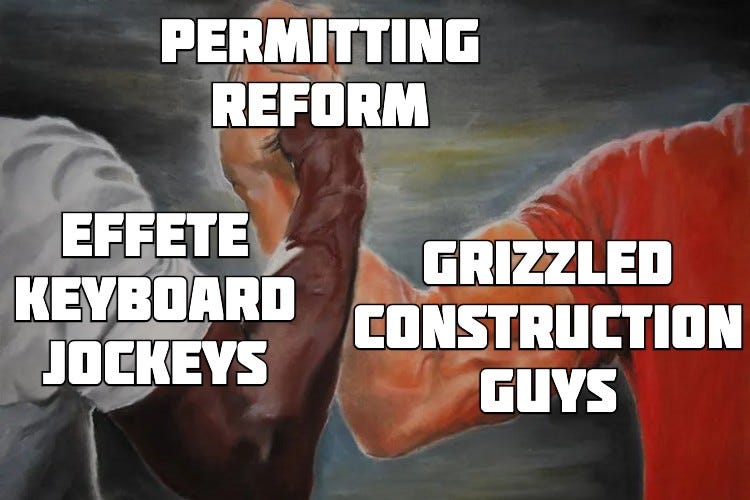
I need to address my biases before I talk about permitting: I come from a construction family. Males in my family traditionally have one of two jobs: 1) Construction, or 2) Drunk who gets hit by a train (though is that really a job?). My dad worked construction until his 30s, then had a mid-life crisis (in construction, 31 is very much “mid-life”), went back to school, and eventually became a college professor. He felt weird about leaving manual labor for an air-conditioned poindexter job, and he passed that guilt down to me: Though I took the effete egghead vocation dynamic to absurd heights by becoming a comedy writer, I cosplay as a construction worker by taking on a massive home renovation project scheduled to be done a few years after my grandchildren die.
The white collar/blue collar dynamic often makes people feel weird. White collar workers know that our jobs are easy; speaking as someone with just enough experience in both types of work to make a comparison, I can confirm that lying on a couch dreaming up jokes about Trump’s hair while interns bring you sandwiches and latees is easier than hauling around roofing beams in 100 degree heat. Your mileage may vary, of course: Construction can be zen, and I’ve have plenty of days working in TV that make me want to lock the doors and burn down the building with myself inside. But something of a house cat/alley cat dynamic exists, and we cats with monogrammed fleece beds perched on windowsills in air-conditioned rooms often feel like neutered — if comfortable — mega-dweebs.
Sometimes, this leads to performative attempts to make common cause with the working man. This is especially true in far-left politics, which I believe is typically an expression of guilt over one’s privilege. And leftists often revel in their ties to labor movements; I’m in the Writers Guild of America, and we have some members who seem to imagine themselves as characters in On The Waterfront even though out top concerns are things like better residuals on syndication of The Mindy Project. Leftists also swoon over people who fit the mold of what they imagine a working-class guy to be, which is why they creamed their jeans over Graham Platner, who embodied many stereotypes about working class guys, especially — unfortunately — the really dark ones.
But the permitting bill currently in Congress reveals how shallow leftists’ affinity for labor unions can be. Leftists strongly oppose the bill; they’ve denounced it as a “Big Tech energy bill” and an “utter catastrophe” pushed by Abundance Democrats. But the bill has strong union support: It’s received the enthusiastic backing of unions representing laborers, electrical workers, and metal workers, not to mention the Teamsters and the AFL-CIO. Broadly speaking, the “Abundance Agenda” is strongly backed by construction unions, because duh: Construction workers build stuff, and Abundance is all about making it easier to build. In this case, technocratic centrists like me are in total accord with the unions, while leftists are prioritizing the views of elite DC activists.
Abundance is often portrayed as a movement of highly educated technocrats, and no one would deny that Jonah-Hill-in-Moneyball-type people are well represented. But the construction part is also very real. The benefits of Abundance don’t just go to people who get more affordable housing, energy, and transportation; they also go to people who build stuff. We often talk about how over-regulation drives up prices by constipating the housing market, but we should also talk about the construction jobs that would exist if our permitting process wasn’t a depraved lawyer orgy.
And the connection between construction and Abundance is key in the broader context of the 21st century job market. It’s often said that people who prefer physical work to sitting at a computer are at a disadvantage in the “knowledge economy”. When people like me note that the future economy is about as likely to be based on coal mining and factory jobs as it is on wagon repair and linotype operation, and that we need to plan for that reality, I’m accused of yelling “Learn to code!” at a 60 year-old coal miner. The grain of truth, of course, is that not everyone wants to sit at a computer struggling to achieve the 90:10 Facebook-to-actual-work ratio required in most offices. Construction jobs are an honest answer to the question: “What will burly dudes do in the 20th century?”
It feels good to have my construction side and my over-educated pantywaist side in accord. I hope that people who oppose the permitting bill while claiming to be pro-union on principle feel cognitive dissonance — they certainly deserve to. If you side with DC lobbyists against unions, then you are not, in fact, pro-union. Perhaps some of the fair-weather union backers should admit that they’re really just anti-business. Because unions have been clear in this case that they support the permitting changes that many-a pampered fancy lad happens to support, too.
“The Common Man Is a Racist Douchebag” Is Not the Populist Message Some People Think It Is

As of this writing, Graham Platner scandals include:
Teamsters Fight Back Against the Horrible Specter of Fewer Traffic Deaths

A self-driving car company takes initial steps to introduce its vehicles to a city. Residents — led by the Teamsters Union — push back, arguing that self-driving cars are unsafe. This happens even though the most comprehensive, peer-reviewed study on the impact of that company’s impact found that their cars dramatically reduced all types of crashes, sometimes as much as 96 percent. Despite data suggesting that driverless cars could reduce injuries and fatalities, city council members appear to side with the Teamsters, using the bizarre argument that the safer cars threaten safety.
There is a direct relationship between white collar and blue collar jobs when it comes to median/average salaries. As more and more people "learn to code" there are fewer people who learn to plumb or wire, and as a result, experienced plumbers and electricians can command higher fees for their services and there is a glut of coders and their median/average salaries plateau or go down and now with AI, we might wind up with a generation of workers who go to vocational schools or become apprentices to learn a trade, because what's the point of going to school for a white collar job that AI might make obsolete?