

Part of what’s happening in France is that there’s a segment of French political culture that valorizes protest. In much the same way that Americans lionize aw-shucks farmers and the British love a witty cad, some French have an affinity for anyone who is pissed off in public. France seems slower than other countries to tell protesters to shut the fuck up and go home, though based on recent polling, it seems that even they have crossed the “shut the fuck up and go home” threshold.
French romanticization of protests is probably partly due to the rousing, populist, heartthrob-laden rebellion depicted in Victor Hugo’s Les Miserables. Contrary to what most Americans think, Les Miserables is not set during the French Revolution, nor is it set during the July Revolution of 1830 or the revolutionary year of 1848. It’s set during a brief-and-failed rebellion that happened in 1832, which sought to spark a popular uprising but face planted. We probably only remember it because: 1) Victor Hugo happened to be sitting in a nearby park when it happened; and 2) Hugh Jackman’s potent-but-not-overbearing masculinity can make just about any movie a hit.
The context of the 1832 rebellion was that France had mostly experienced monarchical rule since the 1789 revolution. The succession of French governments in the preceding decades had basically been this:
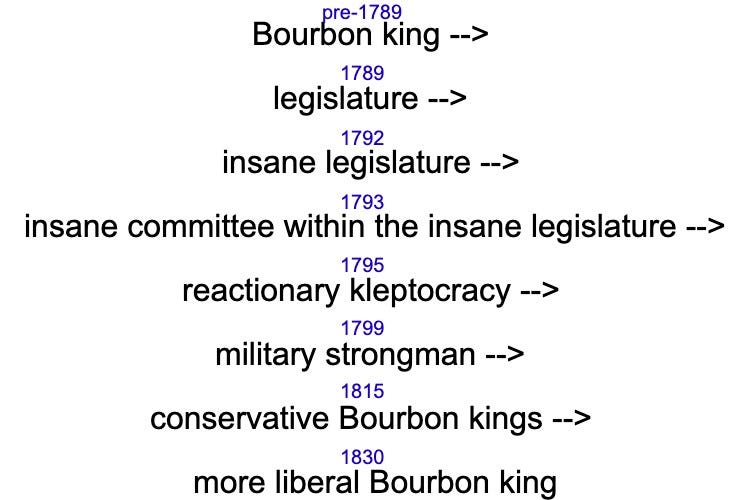
It was that last switch — from a conservative Bourbon king to his more-chilled-out cousin — that really put pleats in revolutionaries’ cockades. They felt that the revolution of 1830 had been betrayed; violent street fighting that left several hundred dead had not produced rule by the people, but rather rule by a guy whom many hoped to be the Bourbon clan’s Michael Bluth. When Gavroche sings about a new king “no better than the last”, he means that new king (Louis Philippe I). Of course, Gavroche is fictional; the real revolutionary “Gavroche” would be a possibly-mentally-disabled mason’s apprentice with a history of violent conduct towards prostitutes.
But the 1832 revolutionaries weren’t just violence-prone Parisian tradesman; they were also often educated young radicals who possibly looked like Eddie Redmayne (though probably not given the hygiene and dentistry standards of the time). Student-led secret societies played a major role in the rebellion, including orchestrating the mechanics1 of the rebellion’s start. Which is notable, because this was not an organic uprising: This was an event planned by secret societies, trade groups, and foreign radicals from Italy and Poland. Les Mis makes it seem like the people, generally were rising up, but the rebellion actually came from a small number of people who tended to rise up at the drop of a chapeau.
And the failure to get the people, generally, to join the revolution was the movement’s achilles heel. The people had, after all, just risen up two years ago, the new guy had barely gotten the seat warm, and many people were republic-shy because the only elected government to that point had mostly invented new methods of mass murder. And when the radicals declared “THE REVOLUTION HAS BEGUN!!!”, most of Paris said “today is not good for me,” and the rebellion was quickly overwhelmed and defeated.
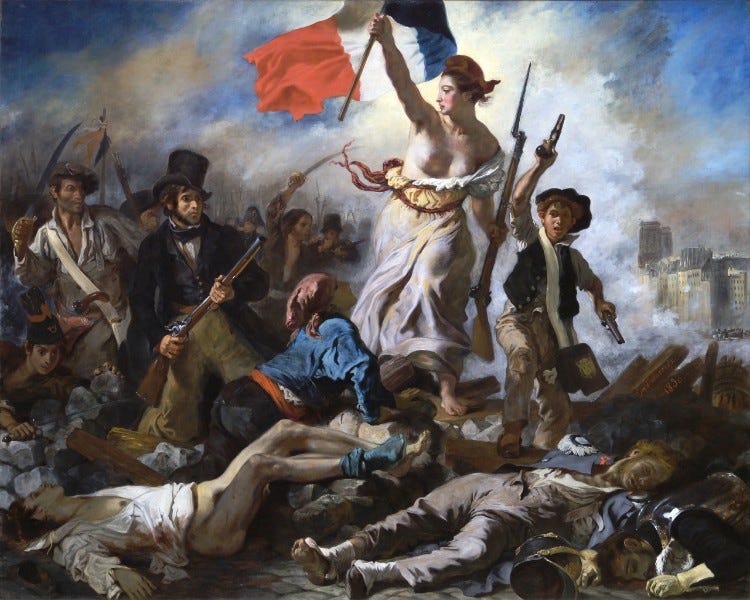
The legacy of the 1832 rebellion was probably to place the government on a more conservative trajectory. A symbolic move after the uprising was the government’s decision to place Liberty Leading the People — the boob-forward painting depicting events 1830 that heads this column — in an attic, because it was too revolutionary. And the government of Louis Philippe trended in an ever-more-conservative direction until it was overthrown in 1848. That revolution did put power in the hands of the people, and in the first popular election since the capital-”r” Revolution, the masses expressed their love for self rule by…electing Napoleon’s nephew in a landslide. And he soon declared himself emperor to little opposition. The complicating fact in every populist narrative is that many people don’t want freedom or rights or any of that high-minded hippie crap: They want to be led by an awesome winner who kicks ass.
But you can understand why Hugo stripped away the inconvenient parts of history and delivered a story about dashing idealists changing the world while sexy. And that archetype seems to be a frequent character in French political narratives. It’s surely part of the reason why any pissed of student in a yellow vest or truck driver with a scorpion in his ass over EU regulations can win support from a certain segment of the French populace. Today’s rioters seem to have exhausted public support and will probably help usher in a more conservative government, which is a case of history rhyming, though not in a lyrical, show-stopping Broadway kind of way.
Why Do Protesters Activate the Rage Center of Our Brains?

People fucking hate these campus protesters. If you want empirical support for that statement, here you go, but I think it was pretty obvious even without numbers. Right-wing media currently knows nothing besides these protests; Jesus could return to Earth, knock up Taylor Swift, and hit 75 home runs for the Marlins, and his exploits would still only make the crawl on Fox News while they aired footage of the dumbass college protester

Specifically: They chose the funeral of a populist French general as the instigating event for the rebellion. And a horseman carrying a red flag with “Liberty or Death” (except French) written on it was the signal to start fighting.
I could not disagree more.
Like most criticism of the ongoing protests, this post disregards the reasons for the protests and the lack of popular support for the current government (which governs through executive orders despite no longer having a majority in parliament). But regardless of how legitimate the protests are, the high-level claims about protesting in general and its electoral consequences are completely off the mark. Here's some evidence that protests work, that they do not alienate voters, and that they have popular support.
The far right has always had a lead in the polls for the 2027 election, and the poll linked is from before the protests (see https://en.wikipedia.org/wiki/Opinion_polling_for_the_2027_French_presidential_election). Tying these polls to the recent protests is a stretch. The reasons for increasing far right popularity are plentiful, but France is not an isolated case, and the first places to look should be racism and paid-for media support (see https://fr.wikipedia.org/wiki/Vincent_Bollor%C3%A9#Construction_d'un_empire_m%C3%A9diatique_conservateur_et_r%C3%A9actionnaire).
There is little historical evidence that protests cause the parties supporting the protests to lose votes. "This is playing into the hands of the far right" is a tired line from the government and some media which intentionally implies that peaceful protests go hand in hand with looting and rioting, and shift the blame for the looting and rioting from the mismanaged and poorly allocated police to the protesters themselves. In reality, none of the political parties or unions calling for protests are calling for violence, looting, or rioting. The leader of the left party, interviewed on the following day, says so explicitly, see https://www.youtube.com/watch?v=c9oy1l8w8Ig.
What does "play into the hands of the far right" is the police doctrine enforced by the current government (escalation, repression) and false accusations (made by the government and relayed by the media) that the left party is responsible for looting and rioting. In Paris, at Place de la Republique, the starting location of the APPROVED protest, the protesters were tear gased repeatedly despite the protest being 100% lawful. It is this kind of police repression which leads to escalating violence. More generally, the brutal repression of protests has caused the European Comission to weigh in, reminding the french governement that "the right to peaceful protest is a fundamental right in all democratic countries and must be protected” (https://agenceurope.eu/en/bulletin/article/13963/22/social-mobilisations-european-commission-calls-for-distinction-between-peaceful-demonstrators-and-those-who-commit-violence).
There is lots of historical precedent for protests resulting in real change. The recent protests are an echo of the 2018 gilet jaunes protests, which were successful in opposing the "carbon tax" proposed by the government (see https://www.radiofrance.fr/franceinter/voici-la-liste-exhaustive-de-tout-ce-que-les-gilets-jaunes-ont-obtenu-depuis-le-debut-du-mouvement-4647551).
The current protests are supported by the majority. They had an unprecendeted turnout, and 55% of pollers support or sympathize with the protests, while only 35% are opposed or hostile (see https://www.commission-des-sondages.fr/notices/files/notices/2026/octobre/10322-pres-mobilisations-sociales-elabe-16-octobre.pdf).
I’m just gonna leave this here:
https://youtu.be/wp84sRpM1Js?is=Snh_vwmRMUysrRfg