

Liberty Mutual insurance has a new spokesperson: It’s this fuzzy polyp with teeth:
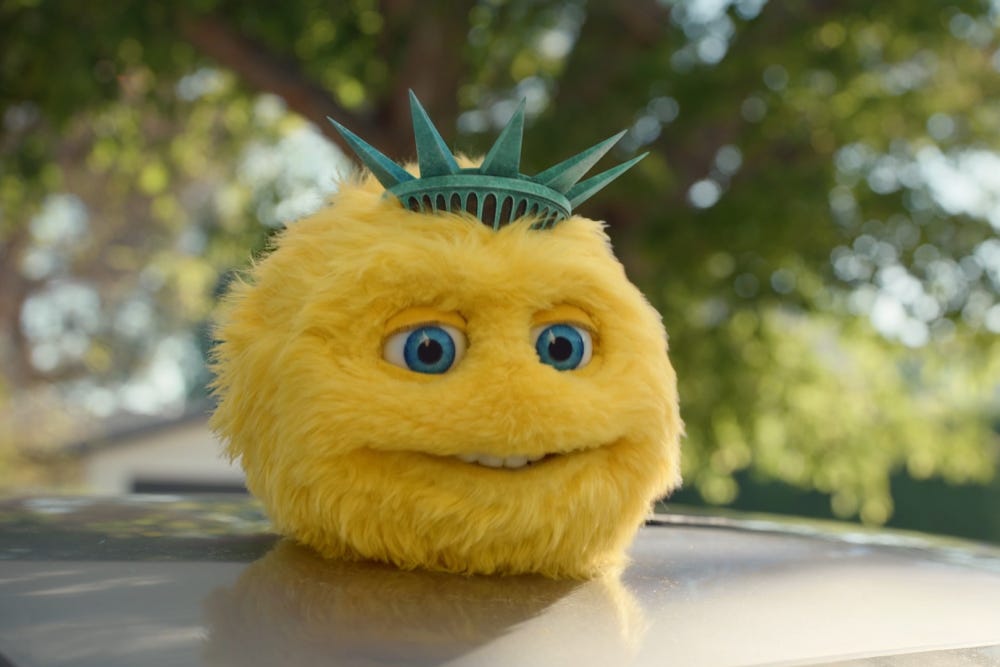
That’s Liberty Bibberty, and you’ve probably encountered…they/them?…if you’ve recently watched football, reality TV, or basically anything broadcast in English. Probably more people know Liberty Bibberty than their member of Congress, and I have no doubt that googling “Libberty Bibberty erotica” would teleport me directly into the heart of darkness.
Liberty Bibberty comes from a riff from a different Liberty Mutual ad — the one with the actor who keeps flubbing his lines. So: Liberty Bibberty is Frasier to that ad’s Cheers. And if you’re thinking “Isn’t Liberty Mutual also the Limu Emu and Doug?” — yes, that is also them. There is basically now a Liberty Mutual Cinematic Universe, with new characters being added all the time.
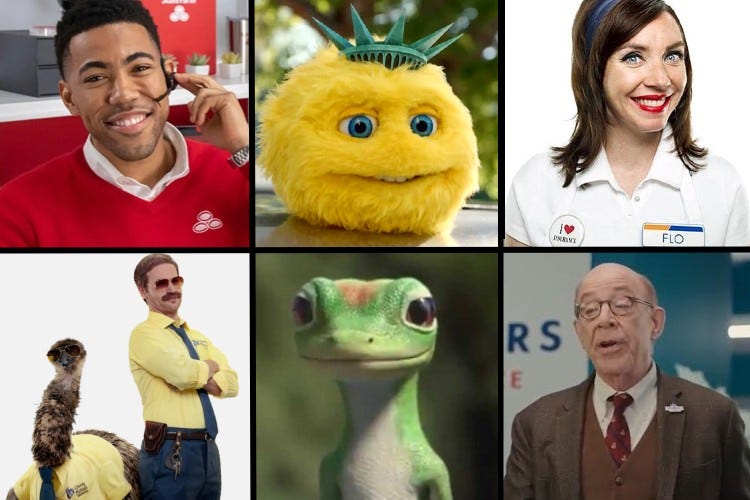
And it’s not just Liberty Mutual: Geico has the Gecko, an endless parade of recurring characters, and a podcast where you can get to know the Gecko better (seriously). Flo From Progressive is perhaps the most fully-realized fictional character since Anna Karenina — we’ve met her family and friends, we know her hopes and dreams. Jake from State Farm has more interactions with American cultural figures than Forrest Gump. The name of the game in most advertising is “cute mascot + sticky catch phrase”, but the name of the game in insurance advertising seems to be “a fully imagined universe of characters whose depth rivals anything imagined by Tolkien or George Lucas.”
Why is that? And where is this headed? Will we eventually have meticulously-crafted insurance character environments complete with histories and cultural divides, like Narnia or Westereos? Will they speak a bespoke language, like Dothraki or Klingon? Will online fandoms tear themselves apart debating whether it’s time for a female Jake from State Farm? I don’t understand the logic that brought us this far, so I don’t know if there are limits — I can’t rule out the possibility of an arc where the Lime Emu and Doug break up and get other partners, or a Roots-esqu saga in which we follow Flo From Progressive’s family through the generations.
I think we may be witnessing the fruits of an ad executive grudge match. If there’s one thing I learned from Mad Men — other than that one way to deal with alcoholism is to just power through — it’s that advertising people are hyper-competitive. Perhaps Geico’s ad agency dominated the Clio Awards in the 2010s, and their competitors sore vengeance. That would explain the arms race, and it would also explain why the ads are episodic and self-referential — a common move when clout-chasing is to get artsy. There might be ad people out there saying “The Geico caveman ads were cute, but the Farmer’s Insurance Guy is modeled on Plato's Phaedrus, who exemplifies the dual nature of man. Which is why we got Golden Globe winner JK Simmons to play him.”
This trend in advertising makes me respect The General. You probably know The General, the cut-rate insurance company that features super-low-budget ads that use the computer graphics from Dire Straits’ Money for Nothing video. The fact that The General has not only resisted the spokesperson inflation trend, but has not followed any trends regarding flashy or even competent advertising — and yet are still a company — makes me think that their product must be great. It’s sort of Big Dick Energy for insurance — not trying at all makes me wonder what’s under the hood.
I fear this age of self-spawning insurance mascots. If one Liberty Mutual ad can generate another, but the original still exists, then there is a real danger of these ads spiraling out of control. What happens when insurance mascots outnumber humans, which is projected to happen in 2028? Drastic measures may be needed to rein this in. Because I’m not convinced that 30-second insurance ads need to represent the apex of human creativity.


Okay, in return for you introducing me to this brilliant ecosystem I am now willing to forgive you for being a filthy casual in the Steak-Umms fandom…
On a slightly more serious note however, I’m actually going to take the complete opposite view and say stuff like this is absolutely brilliant and exactly the right way to go for advertising for two reasons. Firstly, it seems to be an increasingly common argument (which unless I’m misremembering you may even have made yourself) that whilst beneficial in some ways, the decline in linear TV and rise of ad free streaming has come with a fair few drawbacks which have negatively impacted parts of the industry. You can already see it in the way that streaming is moving back to some degree of ads, and there seems to be a growing consensus (particularly amongst middle aged nerds, who are of course *objectively* the demographic with the best taste) that it is both necessary and beneficial for the TV industry to move back in that direction.
At that point, if you’re going be watching ads anyway, it then simply becomes a question of whether you are going to be watching intelligently made ones or lazy ones, and at that point I’m not really sure why someone would pick lazy ones? If the ads can become almost as entertaining as the content itself, you aren’t losing anywhere near as much from having your viewing time taken up by them; as a Brit and fan of ultra low budget D-movies, I watch a lot of stuff off both Channel 4 and ITV, and also Tubi and Plex, and if the ads where anywhere near as good as these it would make the whole viewing experience much more enjoyable.
These examples are good, but if you want the pinnacle of what genuinely entertaining advertising looks like, I can highly recommend this ad from a UK IPA brewery, which is genuinely one of the coolest things I think I watched in a cinema in 2023: https://youtu.be/4x7EzB_TIKo?is=dVqhV94vTk3QcL6a
The other side of things is that fundamentally the goal of an ad is to get you to buy the thing, and the best way to do that is to get you to associate the thing with some sort of (usually specific) positive feeling. That’s a good thing! Done right, an ad should make the experience of eat their food, using their devices, buying their insurance that bit more enjoyable, and provided it’s done in moderation (and ideally the other advertisers are just as good at it as they are) there isn’t really anything lost from this - the fact that getting a Coke a Christmas or whatever feels right just makes Christmas more enjoyable in a way in which nobody loses.
This is one of the reasons why I’m actually less anti-product placement in movies than most people and think it could be another way out the current media rut. Sure, done badly everyone hates it, but that’s already widely known and punished - the trick is to do it right. One good example of this is the recent film Mayday, which makes a point out of going to a McDonald’s at the end in a positive light. Again, good! I want eating a McDonald’s to feel like eating a piece of pure Americana, and if Mayday helps me do this than both me and McDonald’s gain. You could argue this could be harmful in encouraging unhealthy eating, but I feel like the better solution here is for healthy foods to up their game and do a better job!
If you want another peak example of this in play, I would look to the movie Brigsby Bear, which is A: absolutely brilliant and plays directly into the tastes of this blog’s audience, and B: features a bit of product placement for Coca-Cola which is both extremely prominent and focused upon, whilst also fitting seamlessly and naturally into the movie in a way that doesn’t feel in the slightest bit intrusive or inappropriate at all and arguably improves it. It’s the perfect example of a symbiotic relationship - your existing associations with Coke improve the movie, and the movie improves existing associations with Coke. This is what we need more of!
I believe Flo from State Farm was briefly on Mr. Show, so lifetime pass.
And she didn't even ruin it by going to the January 6th riot! 😅