

Three months ago, I wrote a post “setting up the goal posts” to measure how individual candidates did in the midterms. I did that for two reasons: First, I did it to be a dick. I feel that liberals can be too polite, and we bite our tongues in response to the hate and idiocy that DSA types are trying to smuggle into the mainstream — I see a role for a tactless dickweed (me) to say “These clowns are clowns.” Second, I did it because I assumed that Democrats would do well in the midterms, and that left-populists would try to spin that success as proof that Americans are pining for full communism. And, here we are:

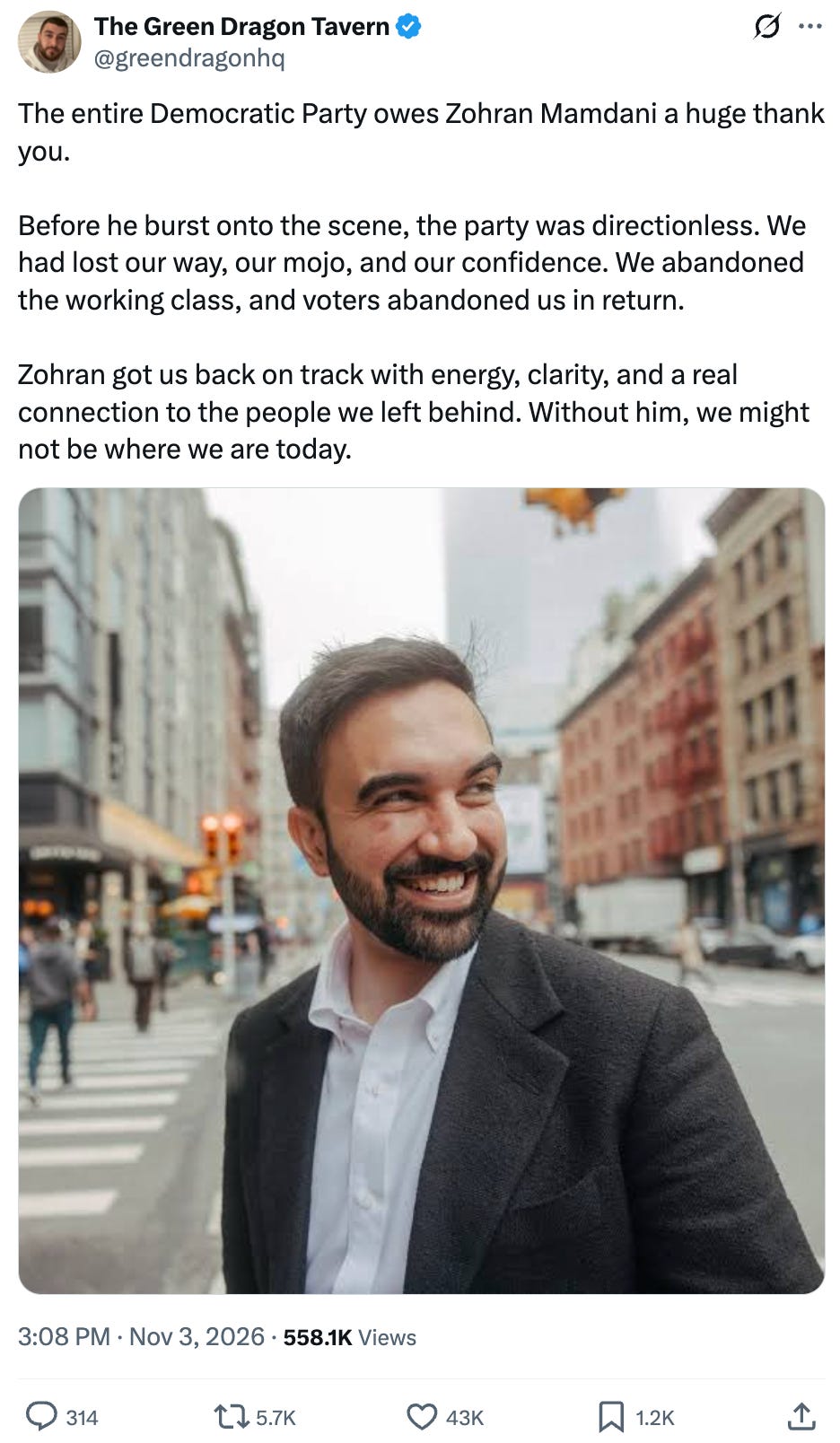
Personally, I’d give more credit to the hoard of establishment Democrats who rode to the rescue of flagging candidates like Abdul El-Sayed than to a blue city mayor who — to my knowledge — didn’t campaign with anyone outside of New York. Of course, the whole reason I wrote and revisited my “setting up the goalposts” column was to make debates like this one irrelevant. We can have this pointless pissing match some other time — today, we have data. So, let’s look at that data.
The first metric I wrote about in August was a Senate candidate’s performance relative to Harris’ performance in 2024. So: If Trump won a state by five in ‘24, and a Democrat won that state by ten last night, that’s a 15 point swing towards the Democrat. As always, I had to make a few choices that I’ll address in this footnote,1 but this was a remarkably clean data set. And, FWIW: The average swing towards Democratic Senate candidates last night was 16.2 points — so much for the “there are no swing voters” theory!
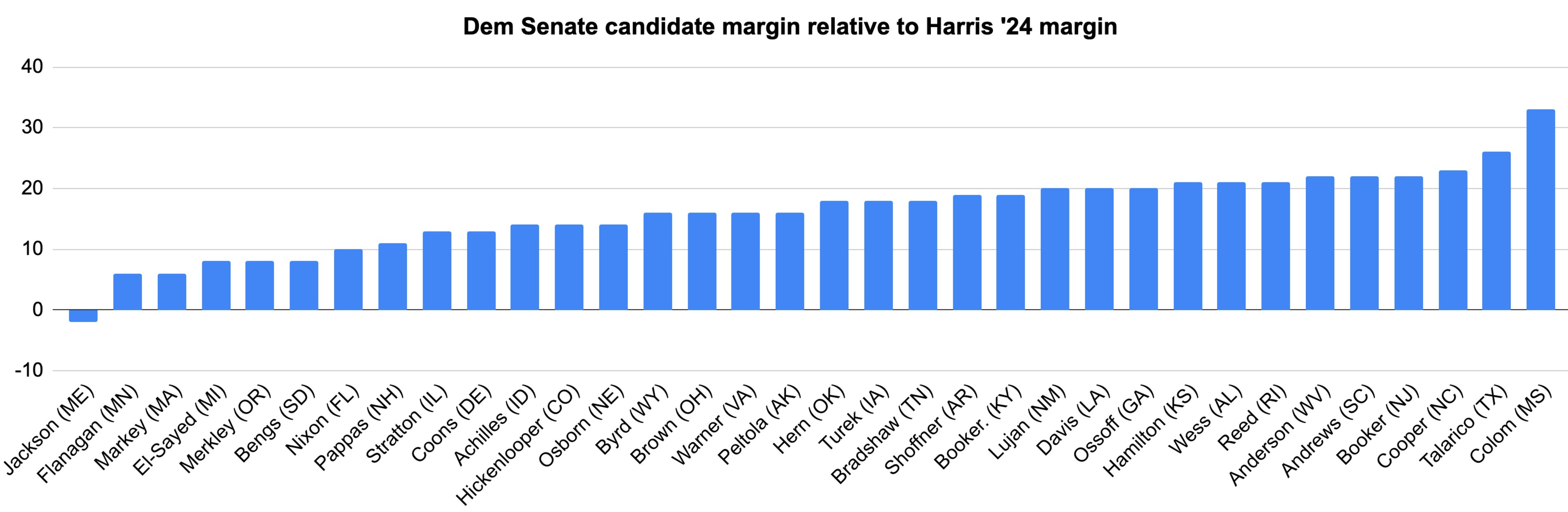
A few notable things:
Leftist candidates did every bit as poorly as I expected, and I’ll write about that more in a minute (and for the next several years);
My prediction that James Talarico would look like a political genius because he ran against a straight-up criminal proved to be correct;
Shout out to the poor performance by Oregon’s Jeff Merkley, a guy who has so distinguished himself as a moron that he’s been singled out for mockery on this blog on three separate occasions.
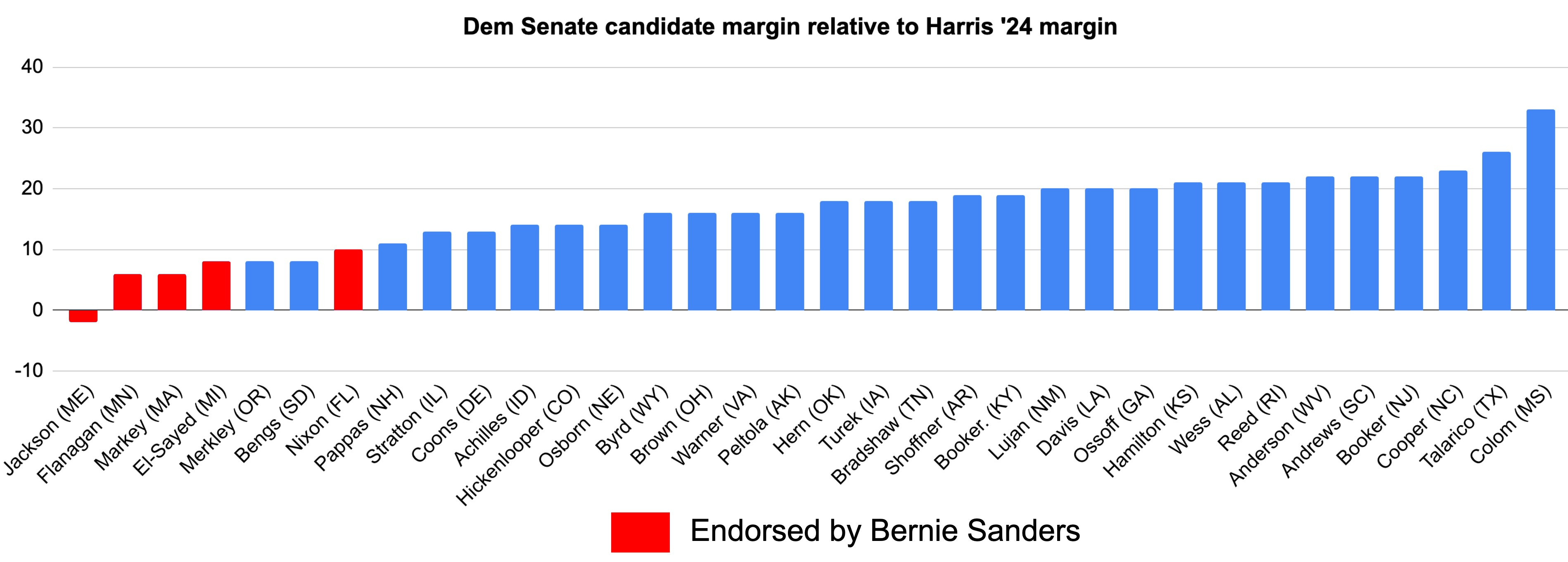
Which of these candidates count as “leftists”? That’s in the eye of the beholder, but a good proxy is: The candidate is a leftist if they were endorsed by Bernie Sanders. Bernie is the DSA’s extremely-elder statesman, and his blessing is why non-DSA members like Troy Jackson and Abdul El-Sayed garnered heavy DSA support. Here is the same chart with the Bernie-endorsed candidates shown in red:
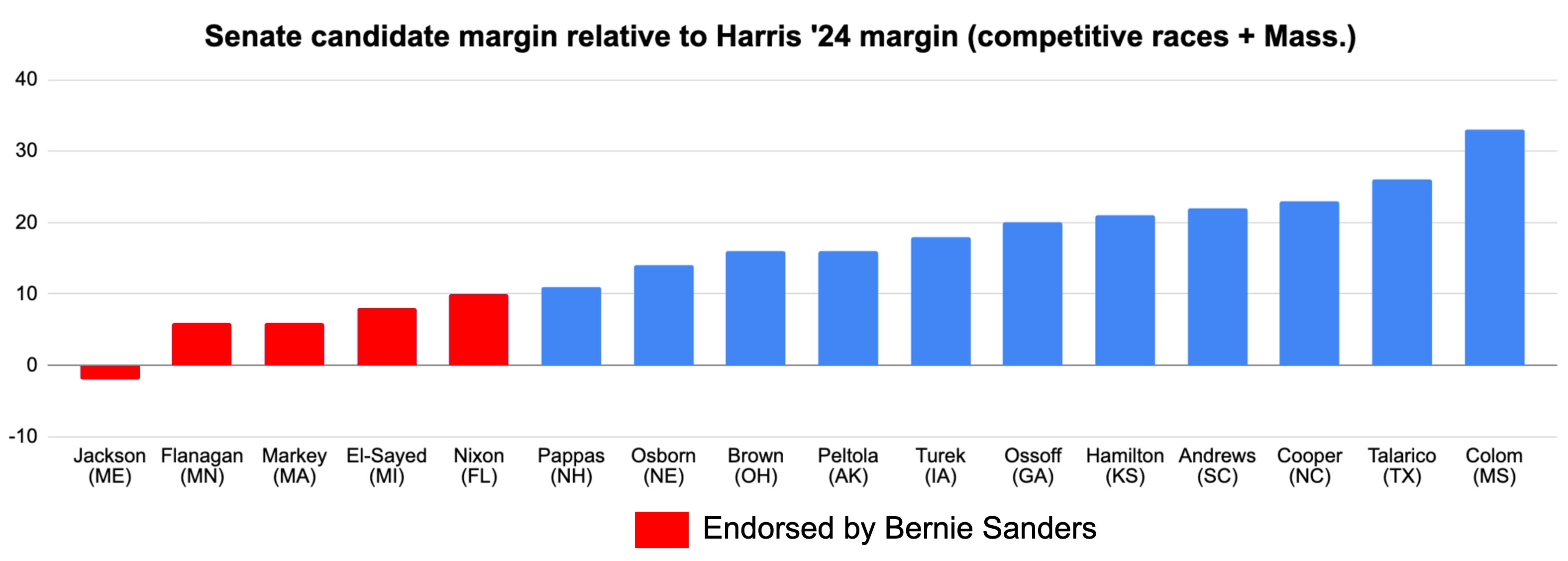
And here’s the same data in an easier-to-read format — in this chart, I removed the races deemed an “easy win” by The New York Times. This not only makes the font easier on the eyes: It acknowledges that non-competitive races can be weird, since there often wasn’t much real campaigning, and the opponent was usually some replacement-level state senator who volunteered to be tossed into the wood chipper for reasons known only to them and their God. So: This is the exact same data with those races removed, except I kept Markey in because I wanted to include all five Bernie-backed candidates:
The second metric I wrote about in August was a candidate’s performance relative to other statewide candidates in their state. Not every Senate candidate had a gubernatorial candidate to be compared to, and in some cases, I’m dealing with incomplete data: Substantial vote is still out in Oregon, Colorado, New Hampshire, and Nebraska.2 The result was a less-complete and more idiosyncratic data set, but here it is:
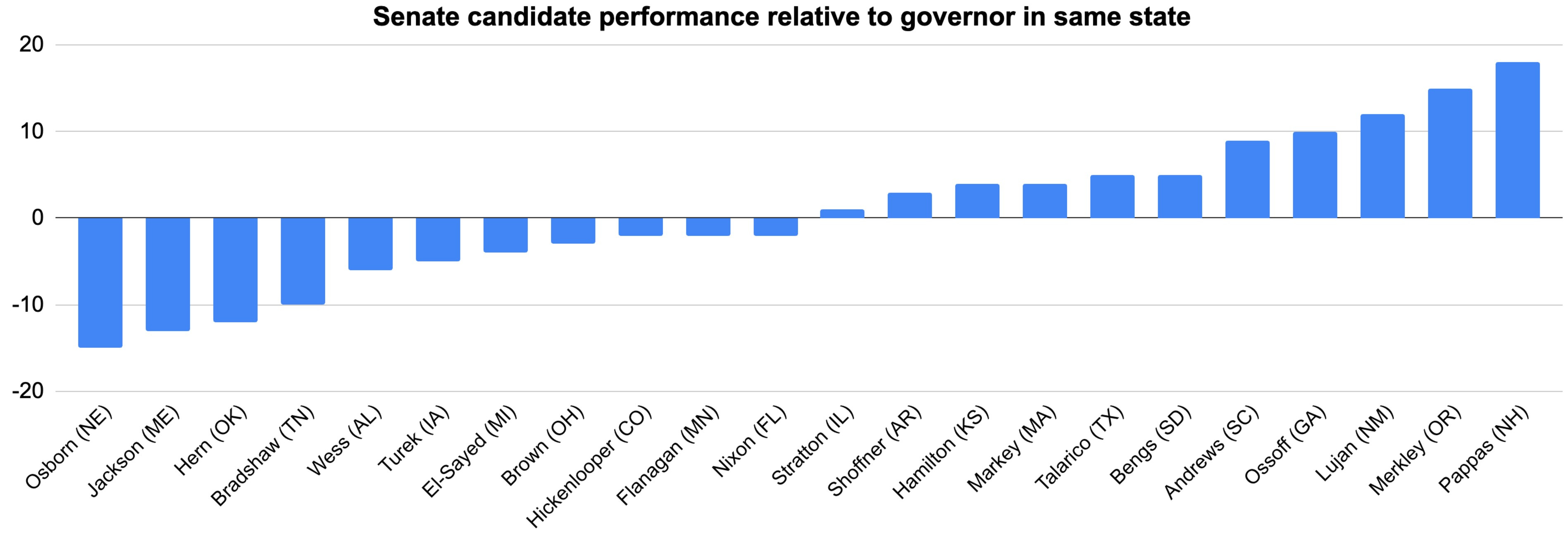
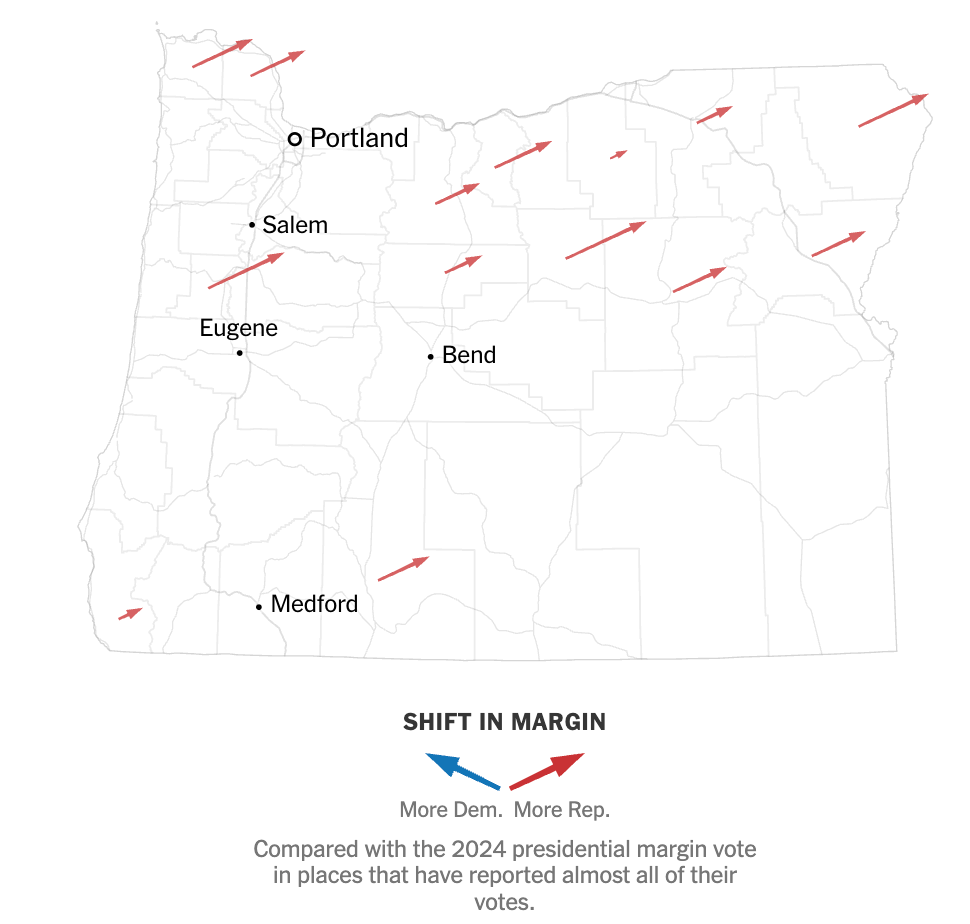
I guess I owe an apology to Jeff Merkley, who at least did better than his state’s unpopular governor, Tina Kotek. I think I need to find out what the hell is going on in Oregon — on a night when red arrows on the New York Times’ “vote shift” map were as rare as a steakhouse in Eugene,3 Kotek’s map looked like this:
And here’s that same data set with the Sanders-endorsed candidates shown in red:
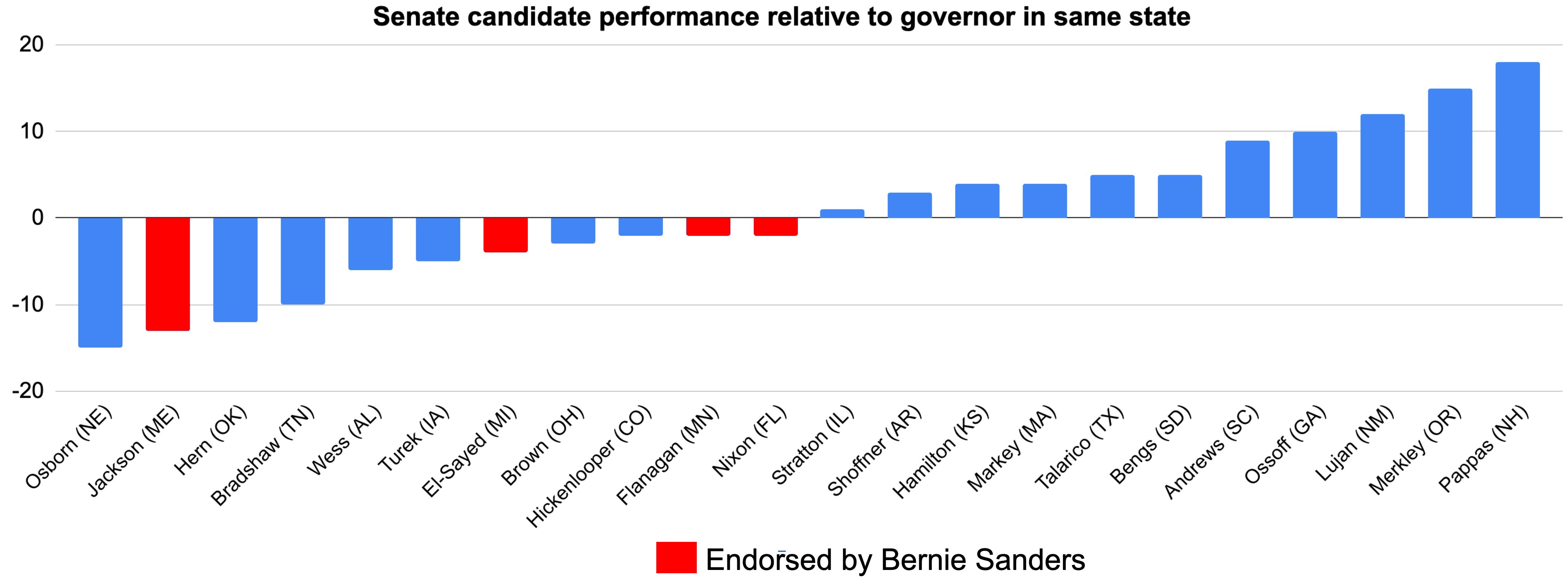
There is no question that moderate Democrats did better than leftist Democrats. The Bernie-endorsed Senate candidates were the worst performers in the whole country in competitive races. Not a single Bernie-endorsed candidate did as well as a normie Democratic gubernatorial candidate in their state. Other people are parsing the same data different ways, but the signal is always the same: Normies do better than leftists.
But frankly: That’s old news. The reason why I tossed myself an alley-oop pass back in August that I knew I would be able to dunk home today is because the notion that far-left politics are broadly unpopular in America is one of the most well-established theories in all of political science. We honestly did not need this data set; there was already exhaustive data demonstrating this truth, and I have been compiling that data and loudly mocking politicians who can’t put two-and-two together for several years. Anyone still making the “secret leftist majority” argument is either a propagandist or a Flat Earther and should be ignored.
And the message is a hopeful one for Democrats: There is a way forward. Voters have resoundingly rejected MAGA — they seem ready to move on. Democrats can capitalize on Republicans’ well-deserved unpopularity if they pursue results, not fringe ideology. And no presidential candidate should be wooing the endorsement of Bernie Sanders, a man who has established himself as King Midas But For Shit Instead Of Gold. The voters have spoken, and they spoke with remarkable clarity; now, Democrats will decide if they’re going to listen.
Reality is Populism’s Kryptonite

They’re still counting ballots in Alaska, where Balto is delivering the remaining vote, and in Maine, where vote counters stop every ten fucking seconds to comment on the beautiful foliage, but even so, it’s clear: Democrats romped last night. And that, of course, is because Trump is extremely unpopular. Some may attribute Democrats’ success to Abdul El-Sayed’s masterful coalition building, or James Talarico’s alpha magnetism — he’s like a bengal tiger riding a Harley! — but I interpret this vote as a loud and simple “fuck Trump”.
Stare Into the Face of Your Populist Revolution

How did the Graham Platner disaster happen? A curse monkey’s paw wish for more Democrats plucked from the SNL “Who’s More Grizzled” sketch? Barack Obama hitting a leprechaun with his car, causing the entire Democratic coalition to be struck with an ancient Celtic curse? I wouldn’t rule either of those things out, but
As I write, not all of the vote is counted, and it won’t be fully counted for a few more days, but I didn’t want to wait until next week to write this column. So, for states where <95% of the vote is counted as of this writing, I used the New York Times’ most recent estimate of the final vote margin. That didn’t change much — it was just a point or two here and there. The states were: Oregon, Colorado, Rhode Island, Massachusetts, Maine, New Hampshire, and Alaska.
In Montana and Nebraska, the primary opponent to the Republican was an independent, not a Democrat. I put independent Dan Osborne of Nebraska into the data set because that was still a two-person race — there simply wasn’t a Democrat in that race. But Montana was a three-person race: An independent got 37 percent and a Democrat got 12. That was just too messy — I threw Montana out (of the data set — they remain in the union).
As I write, a winner has not been declared in Mississippi, but that doesn’t hurt the data set: The margin in that race is almost certainly going to be “zero” regardless of who wins.
I also threw out three-way races in Rhode Island, Idaho, and Alaska, just as I threw out the three-way race in Montana.
I used to live in Eugene! It’s very nice…but awfully Eugene.
Love it! Great methodology, clear predictions, and ice-cold results. Putting a pin in this.
But what counts as leftist or centrist shifts over time as the Overton window moves. That appears to be happening with health care where Americans are more open to universal coverage than they were when Obamacare was passed. Ditto for taxing billionaires and support for Israel, issues where the median Dem has moved left. You also need to distinguish between leftist positions on so-called cultural issues (trans rights) and economics. The latter are much more popular.