

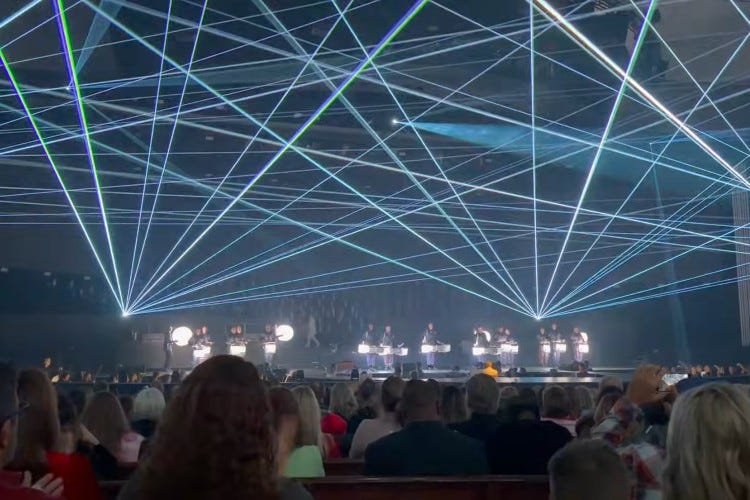
A megachurch in Texas is going viral for its “Christmas Spectacular” service. Here’s a clip — prepare to have the holiday spirit enriched to weapons grade, loaded into a sidewinder missile, and fired directly into your face.
My first reaction to this is that this church desperately needs more gays. Southern baptism has been famously hostile to homosexuality, and those chickens are coming home to roost in the form of sloppy, poorly-executed choreography. The dancers in the front are sinfully out-of-synch; they need a bitchy queen with a cashmere sweater tied around his neck to fire catty insults at them until they are on 👏 the 👏 rhythm.
Some people have opined that this doesn’t look much like church. I agree; I grew up Presbyterian, so “church” to me means dour people in Bill Cosby sweaters making “Ode to Joy” sound like a Morrissey song. If John Calvin could see the glitz in this Christmas Spectacular, he’d go on a shooting spree. To me, this doesn’t seem like church; this seems like the only thing less fun than church, which is Broadway By Straight People.
But who cares what I think? Do we really want me deciding what counts as religion and what doesn’t? On this point — and virtually no others — the Founding Fathers were perfectly clear: We do not. Ironically, freedom of religion requires a heavy dose of agnosticism; each of us is free to believe whatever dumb shit we believe only when we all agree to respond to everyone else’s dumb shit with “sure dude, whatever.”
But there’s a question of whether churches — some of them, or possibly all of them — should be taxed. Right now, churches are tax exempt, and I sometimes get asked for my opinion about that because the John Oliver show once did a piece about how some “churches” that might be better described as “Jesus-adjacent scams” fall under that exemption. FWIW, I had virtually nothing to do with that piece, I parachuted in at the end to add jokes, my only memory of the piece is running into Rachel Dratch at the craft services table and thinking that she seemed like a good hang.
The John Oliver piece focuses on pastors who preach a gospel of sending them money, preferably lots, frequently. A pastor named Robert Tilton — who has been drawing scrutiny and fraud charges since the early ‘90s — runs a ministry that’s a quarter-step up from a Nigerian prince email scam. Several other pastors have gotten rich from their followers’ donations. And of course I think those ministries are scams, but I’m basically a ferret-toting nihilist — I also think that crypto and yoga and about 70 percent of the psychiatric profession are scams. I return again to my liberal agnosticism: My “sure dude, whatever” principle includes the notion that people are free to spend their money in whatever dumb way they want. If someone wants to try to cure their gout by buying a TV preacher an Aspen ski, and I can’t prove that an Aspen ski vacation won’t cure the donor’s gout — which I can’t — then…sure dude, whatever.
But there’s an odd disconnect between the body of the John Oliver piece — which is about TV ministers making claims that most people would consider bullshit — and the conclusion that we should tighten the requirements on churches’ tax-exempt status. If someone is perpetuating a fraud, then the problem is the fraud, not that the fraud is tax-exempt. People can be sued for fraud, and Robert Tilton was.1 The notion that we should give tax exempt status to churches but not the fake ones makes me squirm, because aggressive efforts to distinguish a “real” church from a “fake” one gives the government a lot of power to determine which religions are “real”. And if you don’t see the potential for abuse there, then I’ll point to the recent example of churches and temples coordinating No Kings protests — which Trump would surely love to punish — and also the historical example of everything everywhere for virtually all of human existence.
Churches are ostensibly tax-exempt because they do good. Nonprofit organizations are tax-exempt for the same reason, and in the nonprofit world, an obvious absurdity arises: A group is deemed to be “doing good” no matter what their cause is. You’re “doing good” if you’re trying to feed the homeless, and you’re also “doing good” if you’re trying to skin the homeless and have their pelts sold to Pottery Barn. A pro-abortion group is “doing good”, and an anti-abortion group is “doing good”, too — as long as some manner of a bug is up your ass about abortion, you’re doing God’s work as far as the IRS is concerned. As with churches, the category is vague, bad actors exploit the vagueness, and the IRS takes a light touch because a heavy-handed approach would involve the government making value judgements that we don’t want them making. The problem isn’t that our rules are poorly written or laxly enforced, but rather the very existence of a special category for do-gooders when “good” is impossible to define.
A logical solution — which would be horrifically unpopular, so I’m not officially proposing it — would be to end tax-exempt status for all churches and nonprofits. But I’d like to widen the aperture even further: Why do we tax any organization at all? The question of whether we should tax churches inevitably brings me to my belief that taxing any organization is inherently weird. We generally tax individuals, which makes sense because individuals are the basic unit of politics and their income is fairly easy to determine. But neither condition is true with organizations. The real reason why we tax organizations is probably simply inertia, and also probably because the tax is a hidden cost, i.e. the type of cost that voters love most.
We tax companies’ profits, but that’s an incomplete description of what happens. The full story is that the company generates revenue, some of that revenue gets distributed through the company, and the remainder is called “profit”, which is then taxed. But that middle step matters; people either got pay raises or they didn’t, factories were either built or they weren’t, a thousand horseshit personal perks were either written off as “business expenses” or they weren’t (though they probably were). Who within the company “paid” the tax isn’t clear; most people assume that it’s the higher-ups, but I’m not so sure. The nonprofit world — though ostensibly different — is not that different in practice: A nonprofit won’t report a 20 percent profit, but they could give everyone a 20 percent raise and say “we made no money this year.” An individual’s income is a pretty distinct concept, but asking a company “how much money was left over?” is something of a nonsense question because the company is in a perpetual cycle of revenue and re-investment. And why we should tax an organization instead of the people who comprise the organization is, I think, a question with no good answer.
So, I think my position on whether we should tax churches is “No, and we should also not tax any other organization — we should tax individuals.” People surely would hate this, because to recoup the 6-7 percent of US taxes that come from companies, we’d need to raise taxes elsewhere — people prefer the hidden cost! And me suggesting that we shift the tax burden to things like land taxes and dividend taxes will surely only get me pelted with rotten fruit. So, we’ll probably keep taxing organizations, just not ones that specialize in Southwestern off-Broadway Jesus-based light and laser spectaculars.
A Quick Story About How Leftists Are Sometimes Republicans' Best Friends

Texas Republicans are trying to gerrymander a House map that will give them five additional seats with zero additional votes. This could spark a nation-wide gerrymandering war, which will be like the war in Sudan in that most people will never even know that it’s happening. But if Texas implements the new map and California responds, then we’re one step closer to having our representatives chosen by computers, and not even in a dystopian
Commemorating the Time My Boss Called a Meeting at 9AM on December 23 to Call Us a Bunch of Losers

Today is the 23rd anniversary of perhaps the greatest crime in the history of labor: The time my boss called a meeting at 9AM on Monday, December 23 to inform the office that we were a bunch of twice-baked fuckwits dragging him down. It was the type of move that would have made Ebenezer Scrooge think “what an absolute dickhole”. And I still remember it …
He was found guilty and forced to pay $1.5 million, but that ruling was overturned on a technicality.
Wow. Every paragraph of this I was like yep, but even better would be... and then you'd talk about that thing in the next paragraph.
There are people who treat yoga like a form of exercise that should be preformed “to the max” in a 100 degree room, and there are those who light incense and channel mother Gaia in downward dog. Then there are people like me who struggle with a chronically bad back and fairly constant anxiety who have discovered that yoga is about the only thing that can keep us relatively sane and pain free.